Showing posts with label secularism. Show all posts

Sunday, March 12, 2023

Secular appeal helped Utah to be a big hit at 1893 Chicago Congress


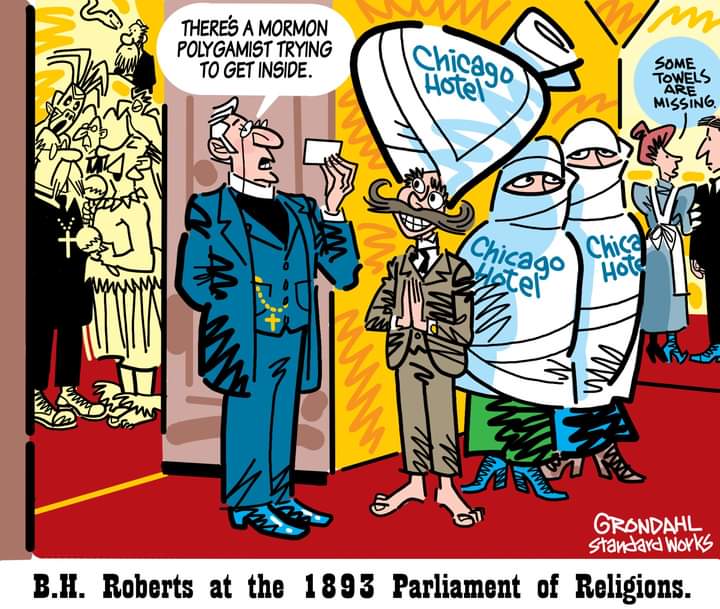
In contrast to the Mormon Church’s bitter rejection at the 1893 Chicago Parliament of Religions, the territory of Utah was warmly received at the Congress of States and Territories, recounts historian Konden R. Smith in his Journal of Mormon History essay, The Dawning of a New Era: Mormonism and the World’s Columbian Exposition of 1893. (Both events were part of the Chicago World’s Fair). As Smith writes, “In contrast to Mormonism’s rejection from the Great all, Utah Territory … was granted the coveted ‘Lot 38’ in the Congress …” Smith adds that Utah was “thrilled.”

“Lot 38” was one of the largest and situated in the middle of the hall. The reason for Utah’s success was simple: Mormons and non-Mormons in the territory — united in a desire to become a state — stayed away from the religious aspects of Utah, and emphasized its secular strengths. As Smith writes, “Its (Utah’s exhibit) central objective was to make a good impression on visitors, creating an image of Utah characterized by its great potential as a valuable future state with exemplary citizens.” 

The successful exhibit focused on “agriculture, mines, manufacturing, fine arts, ethnology and archaeology, education, women’s work, and a bureau of information” from spectators. Ogden Catholic and mineralogist, Dominick Maguire, educated fair attendees on Utah’s minerals. 

The territory promoted its granting of the vote to women as proof of its feminist appeal. Utah’s then-Gov. Caleb W. West, who was not Mormon, dismissed talk of a theological rule in Utah, saying, “In times past there have been struggles and differences, and I mention these only to say that they exist no more. They have been buried and now we bespeak for Utah simply justice,” recounts Smith.

Most notably, the LDS Prophet Wilford W. Woodruff spoke on Utah Day in Chicago, but he spoke not as a religious leader, but as oldest living pioneer, writes Smith. The Congress certainly went a long way toward achieving Utah statehood in three years, and the effort paid off in highly favorable press coverage. The New York Times, for example, dismissing any threats from Mormonism as remants of the now-ended Brigham Young era. 

The Times also derided opponents of Utah statehood as “non-Mormon ministers, who were spouting fears of now-dead policies such as “polygamy,” recounts Smith. Of course, polygamy was not quite gone. It’s amazing that two separate battles were waged by the church; one by itself, the losing effort to include the LDS faith at the Chicago fair; and the other, very successful campaign, with non-Mormons, to promote Utah territory.

As mentioned in the previous post, the Chicago World’s Fair was promoted as the end of the frontier times. In many ways, that is an apt description for the evolution of the Mormon faith. Its determination to be included in national events, its determination to be a state, were in sharp contrast to the church’s anti-government, distrust of external authority it had promoted only a generation or two earlier. 

The current Mormon Church hierarchy is often described — sometimes with admiration, other times less admirably — as having strong public relations skills. Its success at the Congress of States and Territories is proof that today’s promotional skills were inherited from leaders more than 100 years ago. 

The ecuminity between Utah’s Mormons and “gentiles,” Smith explains, was a realization that an end to popular fears and prejudices against the Mormons would benefit all Utah Territory residents.?As Smith also notes, the relatively new Mormon Tabernacle Choir was a big hit in Chicago. The 400-plus members of the Choir performed in Chicago on Sept. 8, 1893, to lots of acclaim, including a favorable review in The Chicago Daily Herald.

It is notable that after the Chicago events were over, Mormon leaders, including George Q. Cannon and Lorenzo Snow, Francis M. Lyman, and Heber J. Grant, at LDS General Conference in October, ignored the repudiation of the church itself and focused on the positive results of Utah’s exposure at the Congress.

As Smith notes, it was a moment of realization for late 19th century Mormons, “that, if they hoped to accomplish their goals as a people — they could not do so when ‘all hell” raged against them. Rather, Mormons by finding acceptance as American citizens who believed in progress and social reform, sought a position of equality rather than marginalization and oppression.”

In short, the secular triumphed over the theological.

-- Doug Gibson

Originally published in 2011 at StandardBlogs.

Sunday, April 25, 2021

Mormonism, secularism cited as sin within USA by late 19th century Protestant America

---

At the 2013 Mormon History Association gathering, in Layton, Utah, there was a discourse delivered by Leigh Eric Schmidt, a professor at Washington University in St. Louis. Schmidt, who is not a member of the Mormon Church, delivered a fascinating address titled, “Mormons, freethinkers and the limits of toleration.” It primarily dealt with how Mormonism, as well as atheism and proponents of secularism, were received by a late-19th century America that was dominated by Protestantism.

In that era, Schmidt explained, freethinkers and Mormons were, of course, miles apart in ideas. The coalition of freethinkers included atheists, agnostics, critics of organized religion, and critics of the era’s rigid sexual mores. Mormons, on the other hand, followed a rigid ecclesiastical authority and professed to follow strong morals. But there was that polygamy thing, which in an era of Protestantism and Republicanism, was considered as libertine and immoral. An example — in 1887, Schmidt said, Mormonism, secularism and atheism were proclaimed as “sin within (the) land” by Presbyterian leaders.

To sum up, 120-plus years ago, atheists and Mormons were both outcasts, oddities to be gawked at by most, and pursued and prosecuted by the more zealous advocates of a approved religious-state.  As Schmidt noted, two separate pieces of legislation, the Edmunds-Tucker Act and the Comstock Act, were in essence “religious tests” for both public comportment as well as “fitness” tests to run for public office. The former was directed at Mormons, the latter politically active freethinkers. Both fell outside of boundaries of American Christianity drawn by Protestants.

In his discourse, Schmidt included an overview of two prominent secularists of that era — Robert Ingersoll and D.M. Bennett — and recapped their visits to Utah as well as their viewpoints on Mormonism. For Ingersoll, who regarded secularism as the best religion — Ingersoll idealized the moral, secular family spending time together in the home on Sundays — Mormonism was an abomination. As Schmidt noted, the conservative freethinker regarded the Utah religion as “horrible” and founded on ignorant superstition.  Ingersoll, Schmidt added, was a monogamist and was not sympathetic to the LDS Church’s persecution by the government.

Schmidt related an interesting 1877 account in which Ingersoll, a frequent traveling lecturer, spoke at the federal courthouse in Salt Lake City. During the lecture, Ingersoll praised the virtues of families and the proper raising of children. In an interesting contrast, notes Schmidt, the anti-Mormon Salt Lake Tribune proclaimed the lecture as an attack on polygamy. However, the Mormon Church-owned Deseret News “loved the speech,” said Schmidt, and wondered in its coverage why Schmidt often referred to domestic life in Utah as prostitution. The remarks were probably ironic, since the editors were certainly aware of Ingersoll’s harsh views on polygamy.

As for D.M. Bennett, the founder of the periodical “The Truth Seeker,” he was a far more radical secularist than Ingersoll. Bennett was also an advocate of free love. His efforts led to his arrest and conviction under the Comstock law. He served 13 months in prison.  As the masthead of “The Truth Seeker” noted, it was “Devoted to: science, morals, free thought, free discussions, liberalism, sexual equality, labor reform, progression, free education and whatever tends to elevate and emancipate the human race.” Conversely, the masthead also noted that religion tended to produce the opposite.

Schmidt noted that Bennett, also a traveling lecturer, visited Salt Lake City often. He also spoke in Ogden. Utah charmed him, and he wrote about his visits in a travel guide he published. He spoke warmly of its Mormon inhabitants, even publicly expressing his opinion that Protestants had no right to criticize Mormons, adding that the residents of Utah were more moral than their critics. However, Bennett was careful to remind his readers that his comments should not be interpreted as approval for Mormon theology. In my opinion, Bennett may have felt empathy for Mormon men jailed for polygamy, as he had experienced the same for his advocacy of morals that were criminally prosecuted.

Schmidt also talked more about the secular publication, “The Truth Seeker,” and its off and on empathy with the Utah Mormons. The famous secular cartoonist, Watson Heston, drew cartoons that included Mormons as being persecuted by mainstream Christianity of that era. In fact, one of his “Truth Seeker” cartoons, “An Example of Christian Consistency,” was reprinted in an 1896 Mormon missionary magazine in Tennessee, Schmidt told the audience. (Although I can’t find a copy of the cartoon “An Example of Christian Consistency,” below is another cartoon from Heston, “The Amusement of the Saints in Heaven,” that offers readers a look at his style.)

However, Heston was no fan of the Utah Mormons, Schmidt said. He was a particularly harsh opponent of polygamy, seeing it as a threat to American womanhood. In fact, Heston’s conservative secularism eventually moved him away from “The Truth Seeker.”

It was an interesting lecture from Schmidt. In fact, I just bought one of his books via Amazon (1). As the secularist movement radicalized and began advocating moral issues at odds with most of America in the late 19th century, its influence waned and adherents moved away, to liberal churches or to the secular Sunday afternoons in the family hearth so treasured by Ingersoll.

Still, as Schmidt noted in his lecture, there were secular activists of that era who saw the potential for a “probable but meaningful alliance” between freethinkers and Mormons. The time frame for this was the latter half of the 19th century, when both were despised by chief opinion-makers.

Ironically, as the 20th century began, Mormonism began a slow but consistent march toward conformity, conservatism and traditionalism while organized freethinker movements became more radical and its organized number declined.

One wonders if events will ever transpire to bring the twain — Mormons and freethinkers — together as allies.

-- Doug Gibson

-- Originally posted at StandardBlogs.

1) The Schmidt book I purchased is “Heaven’s Bride: The Unprintable Life of Ida C. Craddock, American Mystic, Scholar, Sexologist, Martyr and Madwoman,” Basic Books, 2010. Buy it here.

Saturday, August 29, 2020

Map of Heaven advocates more study of afterlife


First, neurosurgeon Eben Alexander published “Proof of Heaven,” his account of a near-death experience he had when in a coma due to a severe meningitis attack. The book was a big success, and not surprisingly has its many admirers and detractors. Claims of an afterlife, not to mention personal accounts, have that whiff of religion that annoys secularists and atheists. On the flip side, just about any claim of a near-death experience is held up as “proof” by believers in the divine.
However, in his follow-up book, “The Map of Heaven” (co-written with Ptolemy Tompkins), Alexander is deliberately de-emphasizing the religious angle to the afterlife, while not completely eliminating it. Instead, Alexander advocates the science of the prenatural, or “supraphysical realms” that exist beyond earth. He argues that the philosophies of Plato, Aristotle, personal experiences -- some noted in the book -- and the work of historical scientists and academics make it necessary to consider the afterlife and near-death experiences as a science to be studied, rather than something based only on faith. The author cites the Division of Perceptual Studies at the University of Virginia as one academic center where consciousness, including perceptions of the afterlife, are being studied.
I found the book persuasive but I’m a believer, and as mentioned, there’s no doubt that a cottage industry trying to debunk Alexander and others will always be around. And to be fair, proof that one can touch is not going to be found in “Map of Heaven.” Alexander believes that all humans have an inherent knowledge of a divine existence, and that to lose it, or enhance it, are acquired traits. He argues that as young children we were more in tune with these perceptions, and that their strength weakens as we age. He further argues that religions -- not one religion -- are tools for humans to regain the spiritual consciousness that we once had as children. In fact, he asserts that just about every religion in the world has as its goal, and accomplishment, a path to understanding the afterlife and the greater consciousness. Our ability to tap into this metaphysical portion of the earth depends on us. The author suggests meditation, and accompanying music, as positive tools.
In the book, Alexander writes, “... it’s important to understand that beneath the ’religion vs. science’ debates that lead nowhere, there is another, deeper, and fantastically fruitful discussion going on. In this discussion, a new group of participants -- people who have undergone near death experiences, out-of-body experiences, and other experiences suggestive of the survival of consciousness -- are increasingly being allowed to describe the experiences they’ve undergone. And a small but select group of scientists have decided to take them seriously; to ponder, with the combination of fierce intellectual rigor and vigorous, empirical open-mindedness that all good science demands, what they might mean.”
Since this is a community with a majority of members of The Church of Jesus Christ of Latter-day Saints, I’ll mention some similarities in “Map of Heaven” to Mormon theology, with the reminder that Alexander appropriately is disinterested in picking a preferred religion. “Map of Heaven” describes an afterlife that is located in the same world we exist and is comprised of several layers of consciousness, each more perfect than the other. In fact, Alexander argues that each object in our world probably has a more-enhanced version of itself in another layer of existence. We enjoy more perfection as we advance to each higher level. 
The book is written kindly; it’s not preachy or supercilious. Nevertheless, Alexander wants the reader to understand that despite their doubts, he knows that an afterlife exists. In fact, he urges that the word “believe” be changed to “know” when it comes to the divine, quoting Carl Jung, who late in his life said, “I don’t believe; I know,” when asked for his stance on the afterlife. Further study on the divine is envisioned by the author as a means toward better understanding a discipline that is with us and has always been with us.
Recognizing the divine, understanding that there is a map of the afterlife, can provide meaning to a world that sometimes seems meaningless. The adversity of the world, great or small, is a preparation for something greater. The author writes, “... ’all shall be well’ is not the same as ’everything is peachy.’ It does not mean the world is without its terrors and sufferings. It means that we can navigate this world if we remember one thing: that beneath its apparent meaninglessness, there is a world of meaning which is rich beyond all imagining.”
As mentioned, this is a subject that is easy to play the skeptic with; perhaps that’s because scoffing at personal experiences involving the afterlife or increased consciousness is easier than wondering if there is something to all this and perhaps even trying to see if we can enhance our own consciousness. I think I can echo Alexander and others that despite what our personal opinion on these issues are, the best stance is to respect the opinions of all involved.
-- Doug Gibson