Sunday, February 20, 2022

B.H. Roberts biography provides an interesting review of his public life


Review by Doug Gibson

John Sillito, professor emeritus of libraries at Weber State University in my home city of Ogden, Utah, has done a really impressive job with "B.H. Roberts: A Life in the Public Arena," Signature, 2021. Its nearly 600 pages make for an interesting biography read, a turn-pager, rare for a book with so much information packed into it.

Although the subject's personal life is not Sillito's primary topic, it is emotional, at times heart-tugging, to read of the young B.H. Roberts, with a father gone and a mother far away in Utah, living a neglected life in England, badly treated by church members who were supposed to be caring well for him while his mother tried to get him to Utah territory.

He finally got to "Zion," walking most of the way with only his sister. When he arrived, he found his mother in another slowly failing marriage. The result was a rougher adolescence that a young man needed, and it likely contributed to a recurring problem with alcoholism, and depression that Roberts dealt with through his life.

Roberts, though, was determined to succeed, and sought an education, graduating from Deseret College. He thrived within the late 18th century LDS church, hierarchy, becoming a member of the First Council of the Seventy, and eventually marrying member Sarah Louisa Smith, a native of Centerville, Utah. 

He later took a second wife, Celia Dibble. Smith and Dibble bore him 15 children.

Roberts was sent on dangerous prostlyting missions, when it really was without purse or script, and threats from the opposition could be deadly. When LDS missionaries were murdered in the deep southern United States, Roberts showed great courage in treking into the dangerous locations, and undercover, retrieving the bodies for proper burial.

Sillito's research is impressive. He's combed archives, letters, transcripts, newspapers and more to present a picture of Roberts, a devout Latter-day Saint, clearly a leader, a great public speaker, researcher and organizer, and a sometimes rebel who clashed with powerful colleagues in the LDS hierarchy. 

Roberts was an active liberal in a time when many of his peers were on the opposite side, preferring to align with business interests. Roberts, disagreed, and found himself in spats with among others, Joseph F. Smith, and Utah's first senator, Reed Smoot. 

Roberts occasional bouts with alcoholism were tolerated by his ecclesiastical leaders, but the closest he came to official church discipline was due to politics, when he and another Democrat, apostle Moses Thatcher, clashed over the LDS hierarchy wanting greater say on members' political activities. Roberts' enthusiastic desire to run for U.S. Congress met with disapproval. They wanted Roberts to back a sort of manifesto that would allow church leaders to approve runs for political office.

Roberts, believing he had been forthright about his political aspirations, offered to leave his leadership callings. He was furious over what he regarded as unfair criticism directed at him. The situation for a time appeared to be untenable for either side.

For a time Roberts shunned church hierarchy, but eventually he was persuaded to accept their concerns without sacrificing his personal political beliefs. 

It's interesting that church leaders spent a lot time talking with Roberts, working to persuade him. It underscores his importance as a leader, missionary, spokesman and writer, Consider how another internal dissident, apostle MosesThatcher was treated. For similar reasons, Thatcher was dropped from the Quorum of the Twelve.

It's entertaining to read of Utah's early days of politics. Sentiment among voters was fluid, moving back and forth, just like today (nationally, not Utah). Interestingly, Roberts for a while opposed women's suffrage, and suffered politically for it. He also opposed high tariffs, which put him at odds with much of elite Utahns of that time.

Sillito does not avoid Roberts' racist views, which he expressed publicly. He was a creature of his times, and was echoing sentiments which were believed and practiced through the LDS Church in those times. 

Roberts was eventually elected to the U.S. Congress, despite having three wives and having been jailed for polygamy. After long hearings, and dreadful national press, Roberts failed to be seated, although he did later receive some badly needed back pay for while he was in Washington. This is my favorite part of Sillito's biography. Roberts was very naive that he could -- as a polygamist -- persuade Congress to seat him, but it shows both his tenacity, and intellectual ability, that he gave it a fight.

As mentioned, Roberts was married three times. His third marriage may have been after the Manifesto. Roberts seems to have partially neglected his earlier wives, particularly his first, preferring to spend most of the time with third wife, Dr. Margaret Curtis Shipp. This particularly caused tension with his first wife, discord that continued even after her death, in which her family made it clear to Roberts he was not welcome at her funeral.

Sillito writes of an incident in which the multi-married Roberts, several years after the Manifesto, appeares to have a serious crush on a young single Mormon woman, Leah Dunford. Sillito provides letters which provide fascinating reading. Nothing eventually happened. Any romance died in embryo. The whole event seems a bit kitschy, except that the young lady, already more or less engaged, was encouraged by her mother, Susa Young Gates, to accept Roberts' interest. These passages underscore the long time it took to deflate the toxic culture of polygamy.

Roberts, despite his 60 years, admirably became a U.S. Army Chaplain and served overseas during World War I. He later served as president of the Eastern States Mission, overseeing mission strategies that are still in use today.

Diabetes caused a physical collapse and after his mission tenure ended in 1927 -- third wife Margaret Shipp died during his mission -- he spent his last years with the Seventies before eventually succumbing to complications of diabetes in 1933. Before he died he suffered a bout of serious depression, what Roberts called the "black dog," when diabetes led to partial foot amputation. When Roberts died in late September of 1933, he was living with his sole living spouse, Celia.

Despite these challenges, Roberts stayed active in the public arena. He represented the LDS Church at the World Parliament of Religions, where he had been snubbed 40 years earlier. This time he was praised by parliament participants. Very late in his life, he was politically active, standing up for Utah miners he believed were being exploited by business interests. 

There's a lot of Roberts that interests me that Sillito omits, such as his writing (I love his novella Corianton), much of his family life, his opinions on the Book of Mormon, and a lot of ecclesiastical details. But that's OK; those issues have been covered in depth. We have a very satisfying biography of a great man's public life. His talents and his flaws are covered. To sum up, Sillito provides a book that shows readers why Roberts had such an impact on the 18th and 19th century LDS church, and why he was a popular church leader, speaker and politician. His influence extended well beyond Utah and Mormonism during his lifetime. 

(The Kindle version of B.H. Roberts: A Life in the Public Arena is only $8.99 as of the above date)

Sunday, January 23, 2022

Maher’s ‘Religulous’ is funny but not too complicated


Bill Maher’s “Religulous,” a film screed against religion, is very funny and has a lot of truth to it. Religion is pretty screwed up. Maher, who hosts an HBO talk show, grabs at a lot of low-hanging fruit to mock the dysfunctional branches of faith.

Among his targets is a group, called Answers in Genesis, that opine dinosaurs were horses for early man. Other easy targets including a rapping suicide bombing enthusiast, radical Islamics and Jews, and a dimwitted U.S. evangelical senator.

Those are the lazy parts of “Religulous,” where Maher, who is a very intelligent debater, ties his foils into frustrated, rhetorical knots. Of course, he has the advantage — he demands proof. The others rely only on faith. One can’t help but feel that one reason Maher despises faith is that he doesn’t know anyone he would deem as cool who believes.

It would have been interesting had Maher tried to examine faith, and its relationship to theology and religious belief. But “Religulous” won’t tread into the serious. It’s designed to mock those who believe in Christ, virgin births, “magic underwear” or take the Bible seriously … you get the picture. It’s manna for the religion of atheism, of which Maher is a high priest … even if he won’t admit to any “faith.” 

Hey Maher! We know there’s a lot of inconsistencies in religion. How about finding some new ones. I’m tired of seeing Ted Haggard in anti-God screeds. How about examining what Camille Paglia points out, that as the world gets more unstable, more of us turn to God. In “Religulous,” Maher is a reverse Glenn Beck without tears, clucking over those “God-lovers.”

Nevertheless, pop atheism, along the lines of Maher, Sam Harris, Christopher Hitchens, Richard Dawkins, has value. There is a lot wrong with religion today. We have one political party whose members are moving away from it, and another whose members have tried to co-opt it into a political party. In Utah, the LDS faith and the Republican Party have what seems to be an eternal marriage. Maher may enrage in “Religulous” (and there are very blasphemous scenes in the film) but he is taking the time to talk with believers and deconstruct their beliefs. That he wins most of the debates underscores a troubling trend with religion — too many believers can’t defend their beliefs.

Maher’s segment on Mormonism, I’m sorry to say, is a real clunker. Instead of confronting the 21st Century LDS Church, he obviously researched old 19th century speeches that are of dubious value today. It provides punch lines for several doctrines, including a very offensive clip involving Mary and God. The only Mormons Maher talks to are a couple who have left the faith, and there’s the requisite “get kicked off property by LDS security” scene. 

I can think of dozens of Mormon scholars Maher could have interviewed and matched wits with but again, in a pop atheist screed, interesting debate only happens by accident. Maher plays funny but not too complicated. 

In fact, the most interesting parts of “Religulous” are when Maher’s subjects match him in intelligence, or at least common sense. A man who plays Jesus at a cheesy amusement park uses faith to debate on even terms. Even Maher admits he was stumped at one point. There are Christians in a battered truck stop church who ask to pray with Maher. To the host’s credit, he is very respectful of his subjects while interviewing them, although the snarkiness comes out when Maher’s with his crew.

Maher’s conversation with a senior Vatican priest, Father Reginald Foster, is alternately the most rewarding and frustrating part of “Religulous.” Foster, a very candid man, agrees with Maher on many points, including that the authors of the Scriptures can’t be relied on to be in sync with what we know today. Rather than press on and learn something, Maher just basks in the praise of having someone agree with him. How interesting it would have been had he tried to learn why Foster agrees with him and still believes in God. That, apparently, is too much for pop atheism — and Maher — to tackle.

As a close friend said, you can learn more about religion watching “Nacho Libre” than “Religulous.”

Agreed, but “Religulous” is slightly funnier. Watch the trailer here.

-- Doug Gibson

-- Originally published long ago at StandardBlogs

Sunday, January 9, 2022

So what exactly is a Son of Perdition?

We Mormons have a name for hell — it’s called Sons of Perdition. We’re pretty confident that Satan, Cain and Judas will be residents there, but after that things get a little hazy. Frankly, we’re not even sure what it’s going to be like, other than God and his minions have no plans to visit. 

We’re not even sure if there are “daughters of perdition” out there in outer darkness. That makes sense because no one wants a Son of Perdition to be able to place his hands on a daughter of any kind. To be honest, we have long been encouraged to not dwell too much on the Sons of Perdition. Instead, as the song goes, we should accentuate the positive, and focus on the greatness of the Celestial Kingdom and happiness.

But I can’t help myself. The case of evangelical pastor Chad Holtz losing his post because he no longer believed that a loving Heavenly Father would burn his children forever and ever reignited my interest in where Old Scratch resides. Frankly, the idea that God would subject his children to a punishment a million times more physically painful than Christ suffered — and let’s face it; lots of people were crucified; that’s no big deal, in the eternal sense — seems to be a doctrine that comes from old Satan himself. The doctrine of sinners in the hands of an angry God ought to go the way of infant damnation. I personally like C.S. Lewis’ definition of hell — detailed in the novella The Great Divorce — where “hell” is where we most feel comfortable in the afterlife.

But back to the Latter-day Saints and Perdition: Standard-Examiner blogger Ryan Jenkins once posted an excellent piece detailing Mormon beliefs on punishment and reward, and God being a deity of salvation, rather than damnation, but we still don’t get an idea of exactly who is ending up there. To be a “Son of Perdition” is to deny the Holy Ghost, but even that creates more questions, as does this quote from the Prophet Joseph Smith: 

"What must a man do to commit the unpardonable sin? He must receive the Holy Ghost, have the heavens opened unto him, and know God, and then sin against Him. After a man has sinned against the Holy Ghost, there is no repentance for him. He has got to say that the sun does not shine while he sees it; he has got to deny Jesus Christ when the heavens have been opened unto him, and to deny the plan of salvation with his eyes open to the truth of it; and from that time he begins to be an enemy." (Teachings of the Prophet Joseph Smith, sel. Joseph Fielding Smith [1976], 358).

If you read Doctrine and Covenants, Section 76, verses 32 through 38, the sufferings of the Sons of Perdition rival the sufferings of the damned in that bizarre Christian novel action “Left Behind” series. “Lakes of fire” and “better for them never to have been born” fill the verses. But the real puzzler — at least to me — is verse 35, which reads that to be a Son of Perdition involves “Having denied the Holy Spirit after having received it, and having denied the Only Begotten Son of the Father, having crucified him unto themselves and put him to an open shame."

That seems to indicate that a Son of Perdition needs to have accepted Christ as his savior, then rejected that belief and done everything to lead others away from Christ. That “Mormon” definition of qualifying for hell seems to jibe with many other Christian beliefs. But what about those evil people who never accepted Christ in the first place? Is a person who was born in the Amazon jungle 500 years ago and enjoyed raping and murdering for sport exempt from hell, or Sons of Perdition because he never had a chance to embrace Christ?

Or, as I’ve heard many LDS brothers and sisters tell me in my lifetime, is the Sons of Perdition reserved for LDS apostates who fight against “the church?” How do they end up in Perdition and that creep I saw profiled on Cable TV on the crime documentary channel escape the “Mormon hell?”

I’m tying myself into the0logical knots here trying to grasp understanding of a concept I admit I don’t understand. But I doubt that makes me unusual. I wonder if LDS Church leaders fully understand Perdition and what it is. And what about the Left Behind crowd or those nitwits who dismiss pastors for believing in a God who doesn’t torture?

Personally, I believe God will be a heck of a lot more merciful than most of us think, but I can’t say that definitively. 

Perhaps the more intriguing question is, why do so many followers of the peaceful Christ buy the allegorical descriptions of a burning, torture-dungeon hell? And what are the motives of those who preach of, advocate, or wish for such a hell or Perdition?

-- Originally published in 2011.

-- Doug Gibson

Sunday, December 26, 2021

I guess I was a missionary who wasn’t pressured to baptize


(This piece was posted to the now-defunct StandardBlogs in July 2013
).

Before I get into my subject, memo to Sunstone fans; the June 2013 issue is the best I have read. Every article — from letters to in-depth features, was a must-read. And filmmaker Richard Dutcher offers an excellent short story, “Expiation.” This week’s blog was partially inspired by (the now late)Tom Kimball, who once handled books at Signature. In a short, personal essay in which Kimball offers his sentiments on watching — as a former Mormon — LDS priesthood holders set apart his LDS son for a mission, he wonders what his son will be like after his mission.

This line stayed with me: “Will the numbers game that rules so many missions open his eyes to my unbelieving view of Mormonism?” The “numbers game.” I have heard accounts, by Mormons and former Mormons, of the salesmanship pressures of baptizing. The “numbers game” pressure is a fixture in contemporary Mormon-themed fiction sold outside Deseret Book. I don’t doubt there’s a “numbers game” but the concept is foreign to me because I , drum roll, never experienced it during my time as a missionary. Not from the president, the assistants, the zonies …

I served an 18-month mission (1983-1984) in the Peru Lima North mission. It was a high-baptizing mission. In the 16 months I was in the field, my companions and I averaged between 8 to 9 baptisms a month. I assume those numbers were about average in the mission. I was in Iquitos (by the Amazon River), Chiclayo, Lima and Chimbote, a city blessed with too many fish factories and seemingly no rules on pollution. In Chimbote, we were frequently assaulted with waves of fish smoke!

Note from today: (The picture above is of the Ayllon family, who myself and my senior companion, Elder Rodger Worthen, taught the Gospel to and baptized the couple. The family has remained active in the LDS. Their sweet son -- standing -- in the photo, Jorge, died a decade-plus later while on his mission. Others in the family have served missions. Rodger, God bless his soul, died in 2020.)

Of course, we were urged to gather prospects, urge a commitment to baptism during the first discussion, and baptize converts, but there was never the follow-up pressure and cheers for baptizers and scorn for non-baptizers. We knocked doors in the AM, studied for a couple of hours in the afternoon (siesta time) and in the late afternoon or evening went to appointments, or knocked doors. Knocking on doors was not a difficult thing to do. I can only recall two occasions when the door was shut in our face.

Recreation was treasured in my mission. We’d get up at 6 am on Mondays to make our Preparation Day as long as possible. My fondest memories are in in Lima, by the Tupac Amaru highway, climbing the hills, early in the morning, in the outskirts of Lima. Near Chiclayo we once visited, via truck, a place sacred to Catholics, called The Cross of Chalpon. There were dozens of these types of trips. They relieved the tension that accompanies 12-hour missionary days six days a week.

On Monday night, there was zone meeting. We reviewed the week, went over procedures, congratulated missionaries on baptisms. But again, no pressure. I wonder if my mission’s easygoing style was due to the numbers of baptisms already being logged? Or was it the strategy of my mission president, an easygoing Idaho farmer named Harvard Bitter. I never saw anything other than good humor from him, and that includes the rare personal visits.

In fact, the “worst” thing that ever happened on my mission was when I was robbed at the Chimbote taxi stop upon arrival there. The casualties were my scriptures, about $70 cash, some Peruvian money, a key chain collection, and the big loss, my mission diary which had logged 15 months of my mission. I hated losing that. I put an ad in the paper, with a reward promised for its return and no questions asked, but maybe the robbers didn’t read the daily paper. (In subsequent weeks I was bemused to see parts of my not inconsiderable key chain collection for sale by street vendors at various locations.)

Warning: Very long sentence follows — Although I realize that my mission diary likely decomposed long ago in a landfill — is it possible that destroyed mission diaries are resurrected in the hereafter? — I still harbor a hope that it’s sitting in some members’ house and that one day, through the magic of social media — which definitely did not exist back then … we weren’t even able to watch LDS conference — I will be reunited with my mission diary, thereby having an absolutely fantastic spiritual anecdote the next time I’m tapped to give a talk in sacrament meeting.

Well, I have digressed from my original topic of not being pressured to baptize. As mentioned, to the best of my memory, I never felt the pressure others describe (even now my Standard Works colleague Cal Grondahl is telling me he was pressured to baptize in his 1969 to 1971 New Zealand mission). The only time I felt harassed was due to an overenthusiastic assistant who was a stickler for rules and was hassling me one day. I exchanged a few sharp words with him, which probably ended my faint hopes of becoming a zone leader. I was a district leader the final eight months of my mission, and was always given responsibilities over sister missionaries. My leadership skills could be summed up as follows: Work hard, and don’t baptize kids unless there’s a member parent or member adult sibling. One overly enthusiastic sister missionary used to complain about my “standards” to President Bitter (I read news magazines and boxing magazines) but the prez just laughed them off. (To be fair, I also polished off the “Book of Mormon” a few times, “Jesus the Christ,” the “Autobiography of Parley P. Pratt,” the “Articles of Faith,” and “Orgullo y Prejucio” (“Pride and Prejudice”), which I picked up in a Chiclayo bookstore.)

This stream of consciousness piece is about over. There’s another article in the current Sunstone, by Scot Denhalter, who ironically was in my mission area several-plus years before I got there. In “The Persistent Impermanence of Memory,” Denhalter argues that our memories may not be what actually occurred. As Denhalter writes, “… as the mind retrieves the raw data of memory for the first time, details needed to establish the logical coherence of the memory’s retelling — details not originally stored or possibly never perceived — can be unconsciously added, while seemingly unnecessary details can be left out or likely lost forever.”

I guess it’s possible my memories are skewed. Maybe I was pressured to baptize. But I doubt it.

-- Doug Gibson

Sunday, November 28, 2021

Is it DeMille, Spielberg or Jackson who wants to direct a movie on Alma?


(Originally published in 2010 on StandardBlogs)

A lifetime of activity in the LDS Church provides more than just an average acquaintance with “The Pearl of Great Price.” You become very well versed in the urban legends of Mormonism. One of the favorite urban legends I heard growing up in Southern California LDS wards was that the late, great director Cecil B. DeMille (“The 10 Commandments”) wanted to make a movie about the Book of Alma in “The Book of Mormon.”

If you’ve never heard of Cecil B. DeMille, that’s OK. In the last couple generation or so, I’ve heard a variation on the DeMille/Alma story. It’s actually the great, living director Steven Spielberg who wants to make a movie based on the book of Alma. If you haven’t heard of Spielberg, maybe in 10 years it will be director Peter Jackson who wants to Alma on the big screen?


The only big-screen film version of “The Book of Mormon” I’ve seen is the low-budget, really bad “Book of Mormon Movie Part I,” which should have been subtitled “Beach Blanket Lehi” for all its depth. True confession: I own that film, and have watched it a few times. The dialogue is so bad that I have a hard time believing that my church would have wanted the production company to make the film. I guess that means perhaps that “The Book of Mormon” is in the public domain, like other classics such as Mary Shelly’s “Frankenstein” or George A. Romero’s film “Night of the Living Dead.” That must be the reason so many cheap cartoonish versions of Alma are available through Living Scriptures, Liken the Scriptures or the LDS Church Distribution Center.

Back to Mormon urban legends: There used to be a fun website that tried to decipher all the Mormon legends out there. The site no longer exists so I won't mention its name. It did not get them all, since there was no listing for DeMille, Spielberg, Alma, etc., but the site claimed an answer to the big “is Alice Cooper a Mormon” debate. I’ve been hearing this one since I was old enough to know who Alice Cooper was. The answer, according to the site was  … a sort of yes. You see Cooper, whose real name is Vincent Furnier, has a dad named Ether Moroni. With a name like that, right … RIGHT. The Furniers belong to an obscure Mormon castoff sect called The Bickertonite Church, also known as The Church of Christ. The church claims The Book of Mormon as its own scripture.

There’s very few members of this “Mormon” church, and I doubt Cooper attends, but dad Ether Moroni was alleged to be an elder in the Bickertonites and, get this, the defunct site said Cooper’s grandad was an apostle in The Bickertonite Church. Now that’s a religious pedigree to be proud of!

There were more questions answered on the site. You "found out" if Elvis read “The Book of Mormon” or if the late LDS Church President Spencer W. Kimball was the model for “Star Wars’” Yoda.

-- Doug Gibson

Thursday, November 11, 2021

All those Mormons who think R-rated films are taboo are wrong


Originally posted in 2009 at StandardBlogs

A couple of years ago my oldest daughter’s accelerated fifth-grade class viewed a film version of the well-regarded novel, “The Devil’s Arithmetic,” which involves a contemporary girl being thrust back in time into the horror of the Holocaust. I was thrilled she had a teacher motivated enough to teach her and others about the Holocaust. Unfortunately, some parents of other students in the class protested and initiated a crusade against the teacher, who was more or less suspended for several days. The parents were enabled by milquetoast district administrators who in my opinion mostly took their embarrassing side. What’s most interesting is that a key argument against the teacher was that she had shown an “R” rated movie. She hadn’t, of course. “The Devil’s Arithmetic” is a TV movie. When I informed an involved party that the film was not R-rated, he seemed very surprised. It was clear the non-existent “R” rating was a big deal.

OK, had an R-rated film been shown to fifth-graders, that would have been a big deal. The irony, though, is among much of the Mormon culture, an R-rated film about the Holocaust would not be tolerated for any ages — are we thinking “Schindler’s List” here? What about the crucifixion? “The Passion of the Christ” is a powerful, well-acted, deeply moving film. Trust me, it’s a much better, more spiritual, more faith-promoting film than the good-hearted “The Testaments.” But I know of an LDS ecclesiastical leader who told his congregation to not see the movie because it was R-rated. I have tried to convince friends who are, like myself, faithful members of the LDS church to see “The Passion of the Christ.” Some have looked at me like I’m the devil trying to tempt Christ to break his fast.

There are many R-rating spurners who are sincere, and avoid all films that cross a moral and personal line that they have set for themselves. I respect that. However, just about every week there are released into theaters PG or PG-13 rated comedy or light drama films with characters and events that are specifically sexual in nature and cast fornication or adultery in a positive light. Many of these films — “The Devil Wears Prada,” “Broadcast News,” “Mamma Mia” — are well-acted, well-produced films. I certainly won’t condemn anyone who enjoys spending two hours escaping real-life watching the films. Those three films, in fact, are among my favorites. My point is that 99 percent of my LDS friends who object to “The Passion of the Christ” don’t object to the PG-13 film at the cineplex; in fact, most have probably watched it.

Look, life is R-rated, and while I admit there’s little of R-rated life I’d want to see on the screen there are subjects, historical, religious or personal, that need an R rating to be effectively told. I know they covered deep subjects well in tame films generations ago, but we were a tamer society then. We laud old films such as “The Good Earth” and “Elmer Gantry” as classics but don’t realize until we read the novels that all the R-rated parts were taken out. A high priest in a former ward once scoffed at my respect for “The Godfather” films. “Edward G. Robinson did it better than Al Pacino, and you can take the family to see the film,” was what he more or less said. Well, I’m a big admirer of Robinson’s sneer, but “The Godfather” is a superb parable of capitalism run amok. It may be the greatest epic tale told on the screen. I’m glad I was able to introduce the trilogy to my wife, who loved the films.

In the past 20-plus years, a myth has grown within the LDS church that members are not supposed to watch any R-rated movies. It’s nonsense. It stems from a speech given by the late prophet Ezra Taft Benson, who advised LDS teenagers to avoid R-rated films. Writer Orson Scott Card, while defending “The Passion of the Christ” in a column, recounted what President Benson actually said: “We counsel you, young men, not to pollute your minds with such degrading matter, for the mind through which this filth passes is never the same afterwards. Don’t see R-rated movies or vulgar videos or participate in any entertainment that is immoral, suggestive, or pornographic. Don’t listen to music that is degrading.” (Ensign, May 1986, p 43)

That makes perfect sense for the youth of the LDS church. They should avoid films such as “Porky’s.” And most R-rated films are not meant for children. But, as Card points out, there is nothing about “The Passion of the Christ” that fits what Benson was warning youth about. Clearly, “immoral, suggestive, or pornographic” entertainment is what we are warned against, not R-rated films.

I don’t expect the myth of R-rated films to ever really go away. I know a family member who promised Heavenly Father a long time ago that she would stop watching R-rated movies. I’m sure He appreciates the gesture, although He’s probably a fan of “Braveheart.”

-- Doug Gibson

Wednesday, October 27, 2021

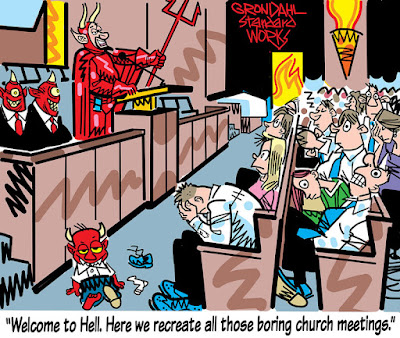
More Cal Grondahl Standard Works cartoons

Here's another sample of Cal Grondahl's Standard Works cartoons, done over a several-year period, roughly about 2009 to early 2014. A website change ended the site (except for Wayback), but these were saved at Flickr and Facebook. We use them on the Culture of Mormonism blog. Enjoy!