Monday, May 30, 2022

Review: Harold B. Lee: Life and Thought


Review by Doug Gibson

Harold B. Lee: Life and Thought, by Newell G. Bringhurst, Signature Books, 2022, provided a lot of information about a prophet of my lifetime who I admit I didn't know much about. Lee was president only slightly more than a year. He ushered in the long, and more popularly significent tenure of Spencer W. Kimball. 

But as author Bringhurst (who penned a biography of Fawn Brodie) notes, Lee had a tremendous effect on how The Church of Jesus Christ of Latter-day Saints moved its way though the 20th century. To note his two major accomplishments, he essentially created the LDS welfare system, and he was the driving force behind church teaching correlation, which more or less is still with us today.

And Lee was so dedicated to his church callings that it's not an exaggeration to say he literally worked himself to death.

Lee, an Idaho native, was both a school teacher and adminstrator in his teens. He quickly gained notice for his skills while a missionary between 1920 and 1922. He married a former sister missionary, Fern Lucinda Tanner, and they raised two girls. Lee was something of a prodigy. Moving out of education, he flourished as a businessman and then a member of the Salt Lake Commission. He became the church's youngest stake president in 1930.

As President of the Pioneer Stake, Lee was noted for his church welfare/Bishop's Storehouse efforts, which were eventually adopted churchwide. Lee shared the general church leadership's sentiments that it was wrong for church members to be dependent on government. Lee eventually was named of the church's entire welfare system.

I get the impression from reading Bringhurst's book that Lee was esteemed enough -- overall -- to have been elected governor of Utah or as a U.S. senator. But his heart was with his church. By 1941 he was called as an apostle and quickly was called to a correlation committee. This proved to be a roughly two-decade project that eventually bore Lee's imprint. As Bringhurst notes, it was a struggle by Lee to rein in the independence many church auxiliaries had. They had enjoyed large budgets and even relative theological independence. 

Lee's skill as an economical money cruncher was also valued, as he worked hard to reduce church debts and move the church toward economic security. These two tasks -- correlation and budget-crunching -- required a leader who could say "no" easily and deal with colleagues' hurt feelings and dashed hopes. 

This is a 156-page biography. I have yet to read more detailed biographies of Lee, that may capture a more familial, softer side. What I gain from the book is a detailed look at a very talented, intelligent church leader who finessed his way through a large bureacracy. He was championed by fellow apostle J. Reuben Clark, who Bringhurst notes was a father figure. Lee's own father had been a bishop disciplined for misusing tithing donations, and there future relationship was strained.

It's very interesting to read about Lee's relationships among his church peers, including David O'McKay, Spencer W. Kimball, and Hugh B. Brown, among others. Lee is best described as an orthodox, mainstream Mormon leader of his times. He strongly embraced the church's incorrect codification of its priesthood ban on blacks, and also incorrectly opposed interracial marriages. He strongly opposed more liberal colleague Hugh B. Brown's public attempts to end the priesthood ban. However, Bringhurst does note that Lee believed the ban would someday be lifted.

Lee was a conservative adminstrator of church interests and was very good at it. Like Gordon B. Hinckley, he was heavily involved in caretaking church affairs before he actually became the prophet. He wrote a lot on church doctrine, including an essay called "The Iron Rod," which as Bringhurst notes, "emphasized obedience." In another essay he decried a society of "black called white and white called black, and sin called good and good called sin." He certainly was an influence for later church leaders such as Hinckley, Thomas S. Monson, and Boyd K. Packer.

A larger biography may have told us more details of his family life. Fern suffered poor health after the birth of two daughters. Soon after she died in 1962, Lee married an age-appropriate second wife, Freda Joan Jenson, who survived him until 1981. I can't get a complete feel of either marriage from the brief biography, other than Bringhurst's note that Fern, 27 to Harold's 24, "possessed a sophistication that Lee lacked." 

As a result, she was a valuable companion as he moved upward. She influenced her husband greatly, particularly in "convincing her husband to change careers." Teaching was low-paying for the Lees, and Harold had several extra jobs while a teacher, including as a watchman for Union Pacific, and as a grocery clerk with ZCMI. Harold eventually began a life of business prosperity as a salesman with Foundation Press, which sold upscale, illustrated stories from the Bible.

I've mentioned Lee was a workaholic. His health started to ebb later in his life and he suffered periodic illnesses. He mostly refused to take breaks or even ease up, though, and was constantly on the go as church president, a role he assumed on July 7, 1972. On Dec. 26, 1973, Lee, 74, woke up feeling very tired despite sleeping 10 hours. His heart was failing, and oxygen did not help. He was dead by 9 p.m., "six hours after his admission to the hospital," writes Bringhurst.

This is an excellent read from a fine writer/historian. The value of learning more about the life of Lee, and other LDS leaders during the 20th century, is that it provides a chart of the evolution of mores, politics, procedures, customs, stances and beliefs within the LDS Church. Lee was an integral part of that history.


Monday, May 16, 2022

Review of three indy books include Mormon presence, and scholarship


i decided to resurrect this post from Wayback. I like these books and hope more people will read them. -- Doug Gibson

I like novels and books from small presses, the independents, those that rely on Kindle, Nook, Smashwords, word-of-mouth … for sales. I read two novels and one scholarly book, from respectively, Strange Violin Editions, Leicester Bay Books, and Xlibris. They are Byuck, a novel by Theric Jepson, well known in the Mormon literary scene, The Hand of Glory, by Stephen Carter, another fixture in Mormon lit, and German Leaves: Opposing Nazi Cannons with Words, by retired academic Ralph P. Vander Heide, a resident of Ogden.

Below are capsule reviews of the books and short interviews with the authors, as well as links to buy the books.

Byuck: This is a crazy book. It’s chaotic but hilariously funny. It’s a satire on life at BYU in
the 1990s and involves two eccentrics, Curses Olai and David Them, to create a rock opera, “Byuck,” which deals with avoiding what is regarded as the main responsibilities of being at BYU, namely matrimony and the ensuing white-shirt-and-tie responsibilities of adult life. The novel is intersected with assorted musings and academic contributions from Dave, such as his “Memory Book,” and lists of spiritual brainstorming from stake conference, and so on. There are witty caricatures, such as Peter, a “macho” BYU guy.

A lot of people have compared Byuck to “Napoleon Dynamite” and I read a review that tagged it with “The Death of a Disco Dancer.” As I told the author, I kept thinking of John Kennedy Toole’s “A Confederacy of Dunces.” The plot’s not similar but it has some of that creative chaos that makes “Confederacy” so memorable. By the way, the history of Jepson’s efforts to get Byuck published, including his dealings with Deseret Book, are as chaotic and hilarious.

The Hand of Glory: This young adult paranormal novel is a genuine horror tale. Carter, who subtitles it “Harrowed Valley Hauntings: Book 1,” has written a spooky story with talented, and chilling illustrations from Galen Dara. The back story of Hand of Glory is steeped in early Mormon history, with polygamy, sin and blood as a means of settling dilemmas. The protagonist is Paul McCallister, 14, who moves to a small Wyoming town. He’s not too happy there, being chased by bullies and wondering where his mom disappeared to. Eventually, Paul’s activities energizes ghosts of a long-ago generation, leading to a scary resolution.

I love antiques, old books and magazines, and anything that shows history at its dustiest. My favorite sections of the novel revolve around Paul’s visits to an old junk shop run by a distant relative.  To sum up, a great read, for kids and adults, but beware, this is not faux scary. It’s creepy.

German Leaves is not a novel, it’s an expanded work of scholarship from academic Ralph P. Vander Heide, who long ago covered the topic while getting a doctorate in German Exile Literature. The topic involves ideas, and writers who became exiles as a result of totalitarianism in Germany, the spread of Nazism.

There’s many subtopics in German Leaves, and my advice is to find sections that pique the readers’ interest and delve right in. I particularly enjoyed a section in which the author notes the failure of organized religion to prevent world wars and proposals, in various literary journals, that posit the idea of atheist-based altruism as a preferable alternative to religion. Whatever the topic, Vander Heide has a passion for “German Leaves” and his writing style is both interesting and provocative.

Here are links, via amazon, to all three of the books reviewed: Below that are interviews with the authors, in this order, Jepson, Carter and Vander Heide:

Byuck: Here

The Hand of Glory: Here

German Leaves …: Here

The interviews:

MeEric, the novel is chaotic but cool. For some bizarre reason, it reminds me of a Mormon version of A Confederacy of Dunces. Question: Is the novel a unique slice of life from 1990s BYU, or is it still relevant to the campus experience today? Also, I read The Motley Fool interview and the process trying to get accepted by Deseret Book is worthy of its own story. After all the talk, receiving a form rejection notice is hilarious. Do you think DB rejects works such as BYUck strictly for marketing reasons, or is a blend of ideology and marketing?

Jepson: “I had a similar experience with Covenant and in that case I know for sure that it was the marketing department that forced the editors to drop it. So I suspect that marketing leads. In fact, I rather think that marketing defines ideology — or, more accurately, perception of customer ideology leads marketing ideology.

“I appreciate the Confederacy of Dunces comparison. I haven’t read that book in years and so I can’t comment on whether any particular influence should be seen — certainly I didn’t include anything intentionally — but you make me want to reread it. In many ways, I think I was too young when I read that one.

“I did a promotion with the BYU Memes Facebook page, but it’s too soon to say how well Byuck captures their experience. I will say that one of the kids at my high school got his hands on a copy and he, a non-Mormon Bay Area 16-year-old son of Russian immigrants, seemed to latch on to it. If he can dig it, surely 2013 Cougars can. But we’ll be testing that when we finally get it into the BYU Bookstore. I’ve been a bit lax about getting that bit of sales done.

Me: “I’m wondering how you market a scary YA tale with a Mormon overview, albeit pretty light.

Have publishers mentioned any concerns with the polygamy backstory? Is their reluctance from traditional Mormons pubs to the content? I know that Twilight isn’t even sold in Deseret Book.

The old shop fascinates me maybe the most. What were some life experiences that helped transmit those pages to the novel?

Carter: “You’re right, the book isn’t Mormon because it presents doctrine or events unique to Mormon life, but because of its interest in how connected we are to our ancestors, and how our actions resonate in worlds we can’t see.

“Interestingly, the Publisher’s Weekly review didn’t mention the Mormonism at all; it was more interested in how the plot has roots in the Bible. It said: ‘A very interesting family history tied closely to the Biblical story of Abraham and his two wives gives a unique angle to this ghost story.’

“I was actually more worried about the Bible story turning readers off than the Mormonism. In an MFA course I attended, we read an essay based on Samson and Delilah, and three-quarters of the class were thoroughly confused. Apparently, the only students who knew the story were the two Mormons and the Baptist minister’s daughter. I don’t think Bible stories are really that well known anymore.

“It was probably inevitable that religion would show up one way or another in this book. I grew up loving the author John Bellairs, and his ghost stories always had Catholicism working in the background. In one series, the protagonist is assisted by a Catholic priest. In another, the protagonist tries to recover the Urim and Thummim from some evil force. (When I read that particular book, I thought, “Hey, Joseph Smith knows where those are!”) The thing that fascinated me about Bellairs’ books was that the key to overcoming evil wasn’t purity or a crucifix or holy water, it was smarts, soul, and a dose of crabbiness. You couldn’t just put your arm to the square and cast out the ghosts, you had to encounter them, figure them out.

“And that’s kind of how I spent my nights as a kid: encountering the possibility of ghosts. Because if you’re a Mormon, you have to believe in ghosts. Your parents can’t tell you there’s no such thing: the scriptures are full of them, LDS Church history is full of them, our theology is full of them. And Mormonism will be the first religion to tell you that ghosts have identities; that they have personalities; that they can be as evil or as good as any human being. So my young self with his overactive imagination would stare into the darkness and wonder who the ghosts were.

“The old shop was one of my favorite parts of the book, too. I based it on a thoroughly amazing place I visit from time to time in Wyoming and mixed it in with memories of filing numerous newspaper clippings away in my grandmother’s dozens of full-size filing cabinets that seemed to multiply while I wasn’t looking. And finally, I added the feel of a dream I sometimes have where I find new, fascinating rooms in a house I thought I knew well. I look forward to exploring the shop further in the next book.

“I’m afraid I don’t have much to tell about trying to get the book into stores yet. We are still finding our way through Deseret Book’s process, and I have no idea how that will turn out.”

MeWhat was the key distinction between the academic work of the past and turning it into a book decades later?

Vander Heide: “The good academics who advised on the dissertation insisted that I write in a logical , ABC (or B follows A) style without  compromise. The final product was not to be a novel!  The professor who reviewed grammar and style, etc. was an editor for the Modern Language Association, which is prestigious in the academic world. Curiously his German pronunciation was so poor that he was the only professor I had who did not conduct his classes in English. The man knew the language inside out as a study in grammar, history, knowledge of lit, but for some reason could not pronounce it. I appreciated his editing skills, but…. 

“I always wanted to write an equally informative and researched study, but a “better read” (or at least less dry).  The story of the Deutsche Blätter is a fascinating one. I wanted it preserved. Germans are no more evil than anyone else and the persons who founded this magazine prove that point. How well educated they were! (They were) true humanists and educated in the tradition of Goethe and Schiller whose portraits appear on the cover. They detested Hitler and  Nazism, but did not believe they represented the true German historically. 

A most daunting obstacle for me was the task of translating all the German passages. It certainly would not, I knew, sell in the USA with so much in German. The university German department did not want translations. So, one good day I had an epiphany to keep it all, i.e. two languages as explained in the preface. “I did it my way” as the song says, concerning the two languages. 

“My second inspiration was to add personal anecdotes including the murder of my cousin in the Netherlands, Dutch women collaborating with the Nazis, so many Netherlanders joining the German armed forces, resistant groups, and the account of the “brain drain.” It seems Hollywood especially profited. However, we also received the learning and wisdom of philosophers, scientists, politicians, so very many. 

“The Leaves is not dry history, but not a novel, of course. Perhaps it is an historical narrative which allows me to grind my ax (axes) and both ask and answer questions. How did Hitler accomplish it ? How could the German people follow him? Could this happen again? Through Dr. Rukser, Mr. Theile and all the contributors I freely examine the questions free (good or bad) from the pressure and power of graduate school professors.”


Sunday, April 3, 2022

Utah’s decision to give women the vote was later rescinded by the feds


Originally published in 2013 at StandardBlogs.

In the 19th century, Utah’s polygamy was often described as one of the twin barbarisms of society, slavery being the other. As historian Thomas G. Alexander writes in the Winter 1970 issue of the Utah Historical Quarterly, “Nineteenth century Utah appeared to non-Mormons or Gentiles, as they were called in the Mormon territory, to be a retrograde and barbarian place only slightly more advanced than the Moslem lands of the Near East, with which it was often compared.”

However, Utah’s leaders at that time were probably more progressive than many people suspect today. As Alexander notes in the JMH article “An Experiment in Progressive Legislation: The Granting of Woman Suffrage in Utah in 1870,” Mormon political leaders in Utah were more progressive than perhaps many have realized. In the Feb. 10, 1869 edition of the Deseret News Weekly, editor George Q. Cannon, also a counselor to LDS President Brigham Young, harshly criticized the capitalist structure that reduced the standard of living for most workers. From Alexander’s article:

“In an editorial he (Cannon) lamented the plight of the American workingman and the problems caused by the rapid centralization of wealth, (writing) ‘in the hands of the very few in this county {which} is unparalleled, and the unprincipled use of the power thus acquired, as witnessed during the recent Wall Street gambling operations {which} cannot but cause wide spread distress.

‘{This shows that} here as elsewhere, when power and wealth are acquired and exercised by the few who are not guided by principle, they are not used pro bono publico, but are made to answer private interests and to subserve selfish ends.’”

Polygamous Utah was presented to eastern audiences through the publication of scandalous “exposes,” hyperbolic penny novels, and smarmy travel accounts by authors who sought to mock the residents of Utah. The truth was far more complex. The LDS religion’s rationale for polygamy, outside of its doctrinal explanation, as Alexander writes, “was seen as a method of reforming society and eradicating social evils by contemporary Mormons. Church leaders saw this reform as a way of freeing women from slavery to the lusts of men and making them honored wives and mothers with homes of their own and social position.”

With this egalitarian theory of the sexes, it’s not surprising that Utah was one of the first states to grant women voting privileges. As Alexander notes, editor Cannon supported women’s suffrage in the Deseret News, arguing that women would do more to promote “legislation of such character as would tend more to diminish prostitution and the various social evils which overwhelm society that anything hitherto devised under universal male suffrage.”

In short, Cannon, and by extension the Mormon leadership, were arguing that a society which allowed both sexes to vote would be a better society. And universal suffrage occurred in Utah 143 years ago. It was the second state, behind Wyoming, to allow the vote in the still-young era of the suffrage movement. On Feb. 12, 1870, acting Gov. S. A. Mann, after receiving the suffrage bill from Speaker of the Utah House, and LDS apostle, Orson Pratt, signed the bill.

Mann signed it with reservations, and Utah Gov. J. Wilson Shafer, who was out of state at the time, said he would have vetoed the bill. The coolness with which these non-Mormon government officials received the suffrage bill underscores the unpopularity and suspicion that Utah was subject to. Nevertheless, on Feb. 14, 1870, women in Utah voted in a Salt Lake City municipal election. As Alexander notes, despite being to second to Wyoming in passing a suffrage bill, due to the timing, Utah women voted before Wyoming women.

There were many prominent women in Utah at the time whose influence extended beyond Utah or the Mormon Church. Emmeline B. Wells, as well as Sarah M. Kimball, were both active in national women’s rights organizations and held positions in the church’s Relief Society. In fact, as Alexander notes, after suffrage, “Relief Society meetings became classes in government, mock trials, and symposia on parliamentary law.” Also, women served on school boards in Utah, as well as a coroner’s jury, and Miss Georgia Snow, a niece to Mormon Judge Zerubbabel Snow, was admitted to the Utah bar, notes Alexander.

The fact is Utah women did not use suffrage as a tool to echo their husband’s or father’s opinions on an issue. By all appearances, they used the privilege of voting in an effective and patriotic manner. Nevertheless, in what was certainly an ironic move by the federal government, Utah women lost suffrage rights due to the Edmunds Tucker Act of 1887. The law disenfranchised all polygamous men and women. Yet, as Alexander notes, a provision to the law took voting rights away from all women in Utah Territory.

A key reason that Utah’s suffrage rights ended after 17 years was because it became clear that granting Utah women voting rights would not bring about an end to polygamy, or elect non-Mormons to office in the state. As Alexander notes, this came as a surprise to outsiders, who shared the near universal disgust of Mormons and the Utah hierarchy of the period. Those who made federal laws, and others with little knowledge of Mormonism, simply did not understand women such as Emmeline B. Wells or Eliza R. Snow, or Sarah M. Kimball, who saw no conflict between their belief in the LDS religion, polygamy and their efforts to better the lives of women.

Alexander dismisses those who believe Mormon men in Utah supported women’s suffrage as a way to consolidate its power in Utah. As he notes, there was a progressive sentiment among Mormon intellectuals in the latter half of the 19th century. In fact, based on the editorials of that era in the Deseret News, it can be argued that the church was far more liberal in that era than it is today. As Alexander writes, “Cannon’s editorials … are progressive and optimistic in tone. They speak of the perfectability of man, the need for equality in the community and the high place of women in Mormon society.”

In fact, several years later after universal suffrage in Utah was snuffed out by the feds, the people of Utah supported it via a huge majority in the 1895 state Constitution.

-- Doug Gibson

Sunday, February 20, 2022

B.H. Roberts biography provides an interesting review of his public life


Review by Doug Gibson

John Sillito, professor emeritus of libraries at Weber State University in my home city of Ogden, Utah, has done a really impressive job with "B.H. Roberts: A Life in the Public Arena," Signature, 2021. Its nearly 600 pages make for an interesting biography read, a turn-pager, rare for a book with so much information packed into it.

Although the subject's personal life is not Sillito's primary topic, it is emotional, at times heart-tugging, to read of the young B.H. Roberts, with a father gone and a mother far away in Utah, living a neglected life in England, badly treated by church members who were supposed to be caring well for him while his mother tried to get him to Utah territory.

He finally got to "Zion," walking most of the way with only his sister. When he arrived, he found his mother in another slowly failing marriage. The result was a rougher adolescence that a young man needed, and it likely contributed to a recurring problem with alcoholism, and depression that Roberts dealt with through his life.

Roberts, though, was determined to succeed, and sought an education, graduating from Deseret College. He thrived within the late 18th century LDS church, hierarchy, becoming a member of the First Council of the Seventy, and eventually marrying member Sarah Louisa Smith, a native of Centerville, Utah. 

He later took a second wife, Celia Dibble. Smith and Dibble bore him 15 children.

Roberts was sent on dangerous prostlyting missions, when it really was without purse or script, and threats from the opposition could be deadly. When LDS missionaries were murdered in the deep southern United States, Roberts showed great courage in treking into the dangerous locations, and undercover, retrieving the bodies for proper burial.

Sillito's research is impressive. He's combed archives, letters, transcripts, newspapers and more to present a picture of Roberts, a devout Latter-day Saint, clearly a leader, a great public speaker, researcher and organizer, and a sometimes rebel who clashed with powerful colleagues in the LDS hierarchy. 

Roberts was an active liberal in a time when many of his peers were on the opposite side, preferring to align with business interests. Roberts, disagreed, and found himself in spats with among others, Joseph F. Smith, and Utah's first senator, Reed Smoot. 

Roberts occasional bouts with alcoholism were tolerated by his ecclesiastical leaders, but the closest he came to official church discipline was due to politics, when he and another Democrat, apostle Moses Thatcher, clashed over the LDS hierarchy wanting greater say on members' political activities. Roberts' enthusiastic desire to run for U.S. Congress met with disapproval. They wanted Roberts to back a sort of manifesto that would allow church leaders to approve runs for political office.

Roberts, believing he had been forthright about his political aspirations, offered to leave his leadership callings. He was furious over what he regarded as unfair criticism directed at him. The situation for a time appeared to be untenable for either side.

For a time Roberts shunned church hierarchy, but eventually he was persuaded to accept their concerns without sacrificing his personal political beliefs. 

It's interesting that church leaders spent a lot time talking with Roberts, working to persuade him. It underscores his importance as a leader, missionary, spokesman and writer, Consider how another internal dissident, apostle MosesThatcher was treated. For similar reasons, Thatcher was dropped from the Quorum of the Twelve.

It's entertaining to read of Utah's early days of politics. Sentiment among voters was fluid, moving back and forth, just like today (nationally, not Utah). Interestingly, Roberts for a while opposed women's suffrage, and suffered politically for it. He also opposed high tariffs, which put him at odds with much of elite Utahns of that time.

Sillito does not avoid Roberts' racist views, which he expressed publicly. He was a creature of his times, and was echoing sentiments which were believed and practiced through the LDS Church in those times. 

Roberts was eventually elected to the U.S. Congress, despite having three wives and having been jailed for polygamy. After long hearings, and dreadful national press, Roberts failed to be seated, although he did later receive some badly needed back pay for while he was in Washington. This is my favorite part of Sillito's biography. Roberts was very naive that he could -- as a polygamist -- persuade Congress to seat him, but it shows both his tenacity, and intellectual ability, that he gave it a fight.

As mentioned, Roberts was married three times. His third marriage may have been after the Manifesto. Roberts seems to have partially neglected his earlier wives, particularly his first, preferring to spend most of the time with third wife, Dr. Margaret Curtis Shipp. This particularly caused tension with his first wife, discord that continued even after her death, in which her family made it clear to Roberts he was not welcome at her funeral.

Sillito writes of an incident in which the multi-married Roberts, several years after the Manifesto, appeares to have a serious crush on a young single Mormon woman, Leah Dunford. Sillito provides letters which provide fascinating reading. Nothing eventually happened. Any romance died in embryo. The whole event seems a bit kitschy, except that the young lady, already more or less engaged, was encouraged by her mother, Susa Young Gates, to accept Roberts' interest. These passages underscore the long time it took to deflate the toxic culture of polygamy.

Roberts, despite his 60 years, admirably became a U.S. Army Chaplain and served overseas during World War I. He later served as president of the Eastern States Mission, overseeing mission strategies that are still in use today.

Diabetes caused a physical collapse and after his mission tenure ended in 1927 -- third wife Margaret Shipp died during his mission -- he spent his last years with the Seventies before eventually succumbing to complications of diabetes in 1933. Before he died he suffered a bout of serious depression, what Roberts called the "black dog," when diabetes led to partial foot amputation. When Roberts died in late September of 1933, he was living with his sole living spouse, Celia.

Despite these challenges, Roberts stayed active in the public arena. He represented the LDS Church at the World Parliament of Religions, where he had been snubbed 40 years earlier. This time he was praised by parliament participants. Very late in his life, he was politically active, standing up for Utah miners he believed were being exploited by business interests. 

There's a lot of Roberts that interests me that Sillito omits, such as his writing (I love his novella Corianton), much of his family life, his opinions on the Book of Mormon, and a lot of ecclesiastical details. But that's OK; those issues have been covered in depth. We have a very satisfying biography of a great man's public life. His talents and his flaws are covered. To sum up, Sillito provides a book that shows readers why Roberts had such an impact on the 18th and 19th century LDS church, and why he was a popular church leader, speaker and politician. His influence extended well beyond Utah and Mormonism during his lifetime. 

(The Kindle version of B.H. Roberts: A Life in the Public Arena is only $8.99 as of the above date)

Sunday, January 23, 2022

Maher’s ‘Religulous’ is funny but not too complicated


Bill Maher’s “Religulous,” a film screed against religion, is very funny and has a lot of truth to it. Religion is pretty screwed up. Maher, who hosts an HBO talk show, grabs at a lot of low-hanging fruit to mock the dysfunctional branches of faith.

Among his targets is a group, called Answers in Genesis, that opine dinosaurs were horses for early man. Other easy targets including a rapping suicide bombing enthusiast, radical Islamics and Jews, and a dimwitted U.S. evangelical senator.

Those are the lazy parts of “Religulous,” where Maher, who is a very intelligent debater, ties his foils into frustrated, rhetorical knots. Of course, he has the advantage — he demands proof. The others rely only on faith. One can’t help but feel that one reason Maher despises faith is that he doesn’t know anyone he would deem as cool who believes.

It would have been interesting had Maher tried to examine faith, and its relationship to theology and religious belief. But “Religulous” won’t tread into the serious. It’s designed to mock those who believe in Christ, virgin births, “magic underwear” or take the Bible seriously … you get the picture. It’s manna for the religion of atheism, of which Maher is a high priest … even if he won’t admit to any “faith.” 

Hey Maher! We know there’s a lot of inconsistencies in religion. How about finding some new ones. I’m tired of seeing Ted Haggard in anti-God screeds. How about examining what Camille Paglia points out, that as the world gets more unstable, more of us turn to God. In “Religulous,” Maher is a reverse Glenn Beck without tears, clucking over those “God-lovers.”

Nevertheless, pop atheism, along the lines of Maher, Sam Harris, Christopher Hitchens, Richard Dawkins, has value. There is a lot wrong with religion today. We have one political party whose members are moving away from it, and another whose members have tried to co-opt it into a political party. In Utah, the LDS faith and the Republican Party have what seems to be an eternal marriage. Maher may enrage in “Religulous” (and there are very blasphemous scenes in the film) but he is taking the time to talk with believers and deconstruct their beliefs. That he wins most of the debates underscores a troubling trend with religion — too many believers can’t defend their beliefs.

Maher’s segment on Mormonism, I’m sorry to say, is a real clunker. Instead of confronting the 21st Century LDS Church, he obviously researched old 19th century speeches that are of dubious value today. It provides punch lines for several doctrines, including a very offensive clip involving Mary and God. The only Mormons Maher talks to are a couple who have left the faith, and there’s the requisite “get kicked off property by LDS security” scene. 

I can think of dozens of Mormon scholars Maher could have interviewed and matched wits with but again, in a pop atheist screed, interesting debate only happens by accident. Maher plays funny but not too complicated. 

In fact, the most interesting parts of “Religulous” are when Maher’s subjects match him in intelligence, or at least common sense. A man who plays Jesus at a cheesy amusement park uses faith to debate on even terms. Even Maher admits he was stumped at one point. There are Christians in a battered truck stop church who ask to pray with Maher. To the host’s credit, he is very respectful of his subjects while interviewing them, although the snarkiness comes out when Maher’s with his crew.

Maher’s conversation with a senior Vatican priest, Father Reginald Foster, is alternately the most rewarding and frustrating part of “Religulous.” Foster, a very candid man, agrees with Maher on many points, including that the authors of the Scriptures can’t be relied on to be in sync with what we know today. Rather than press on and learn something, Maher just basks in the praise of having someone agree with him. How interesting it would have been had he tried to learn why Foster agrees with him and still believes in God. That, apparently, is too much for pop atheism — and Maher — to tackle.

As a close friend said, you can learn more about religion watching “Nacho Libre” than “Religulous.”

Agreed, but “Religulous” is slightly funnier. Watch the trailer here.

-- Doug Gibson

-- Originally published long ago at StandardBlogs

Sunday, January 9, 2022

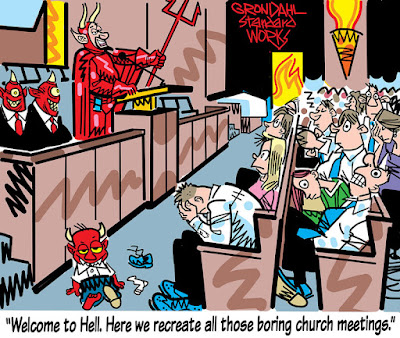
So what exactly is a Son of Perdition?

We Mormons have a name for hell — it’s called Sons of Perdition. We’re pretty confident that Satan, Cain and Judas will be residents there, but after that things get a little hazy. Frankly, we’re not even sure what it’s going to be like, other than God and his minions have no plans to visit. 

We’re not even sure if there are “daughters of perdition” out there in outer darkness. That makes sense because no one wants a Son of Perdition to be able to place his hands on a daughter of any kind. To be honest, we have long been encouraged to not dwell too much on the Sons of Perdition. Instead, as the song goes, we should accentuate the positive, and focus on the greatness of the Celestial Kingdom and happiness.

But I can’t help myself. The case of evangelical pastor Chad Holtz losing his post because he no longer believed that a loving Heavenly Father would burn his children forever and ever reignited my interest in where Old Scratch resides. Frankly, the idea that God would subject his children to a punishment a million times more physically painful than Christ suffered — and let’s face it; lots of people were crucified; that’s no big deal, in the eternal sense — seems to be a doctrine that comes from old Satan himself. The doctrine of sinners in the hands of an angry God ought to go the way of infant damnation. I personally like C.S. Lewis’ definition of hell — detailed in the novella The Great Divorce — where “hell” is where we most feel comfortable in the afterlife.

But back to the Latter-day Saints and Perdition: Standard-Examiner blogger Ryan Jenkins once posted an excellent piece detailing Mormon beliefs on punishment and reward, and God being a deity of salvation, rather than damnation, but we still don’t get an idea of exactly who is ending up there. To be a “Son of Perdition” is to deny the Holy Ghost, but even that creates more questions, as does this quote from the Prophet Joseph Smith: 

"What must a man do to commit the unpardonable sin? He must receive the Holy Ghost, have the heavens opened unto him, and know God, and then sin against Him. After a man has sinned against the Holy Ghost, there is no repentance for him. He has got to say that the sun does not shine while he sees it; he has got to deny Jesus Christ when the heavens have been opened unto him, and to deny the plan of salvation with his eyes open to the truth of it; and from that time he begins to be an enemy." (Teachings of the Prophet Joseph Smith, sel. Joseph Fielding Smith [1976], 358).

If you read Doctrine and Covenants, Section 76, verses 32 through 38, the sufferings of the Sons of Perdition rival the sufferings of the damned in that bizarre Christian novel action “Left Behind” series. “Lakes of fire” and “better for them never to have been born” fill the verses. But the real puzzler — at least to me — is verse 35, which reads that to be a Son of Perdition involves “Having denied the Holy Spirit after having received it, and having denied the Only Begotten Son of the Father, having crucified him unto themselves and put him to an open shame."

That seems to indicate that a Son of Perdition needs to have accepted Christ as his savior, then rejected that belief and done everything to lead others away from Christ. That “Mormon” definition of qualifying for hell seems to jibe with many other Christian beliefs. But what about those evil people who never accepted Christ in the first place? Is a person who was born in the Amazon jungle 500 years ago and enjoyed raping and murdering for sport exempt from hell, or Sons of Perdition because he never had a chance to embrace Christ?

Or, as I’ve heard many LDS brothers and sisters tell me in my lifetime, is the Sons of Perdition reserved for LDS apostates who fight against “the church?” How do they end up in Perdition and that creep I saw profiled on Cable TV on the crime documentary channel escape the “Mormon hell?”

I’m tying myself into the0logical knots here trying to grasp understanding of a concept I admit I don’t understand. But I doubt that makes me unusual. I wonder if LDS Church leaders fully understand Perdition and what it is. And what about the Left Behind crowd or those nitwits who dismiss pastors for believing in a God who doesn’t torture?

Personally, I believe God will be a heck of a lot more merciful than most of us think, but I can’t say that definitively. 

Perhaps the more intriguing question is, why do so many followers of the peaceful Christ buy the allegorical descriptions of a burning, torture-dungeon hell? And what are the motives of those who preach of, advocate, or wish for such a hell or Perdition?

-- Originally published in 2011.

-- Doug Gibson

Sunday, December 26, 2021

I guess I was a missionary who wasn’t pressured to baptize


(This piece was posted to the now-defunct StandardBlogs in July 2013
).

Before I get into my subject, memo to Sunstone fans; the June 2013 issue is the best I have read. Every article — from letters to in-depth features, was a must-read. And filmmaker Richard Dutcher offers an excellent short story, “Expiation.” This week’s blog was partially inspired by (the now late)Tom Kimball, who once handled books at Signature. In a short, personal essay in which Kimball offers his sentiments on watching — as a former Mormon — LDS priesthood holders set apart his LDS son for a mission, he wonders what his son will be like after his mission.

This line stayed with me: “Will the numbers game that rules so many missions open his eyes to my unbelieving view of Mormonism?” The “numbers game.” I have heard accounts, by Mormons and former Mormons, of the salesmanship pressures of baptizing. The “numbers game” pressure is a fixture in contemporary Mormon-themed fiction sold outside Deseret Book. I don’t doubt there’s a “numbers game” but the concept is foreign to me because I , drum roll, never experienced it during my time as a missionary. Not from the president, the assistants, the zonies …

I served an 18-month mission (1983-1984) in the Peru Lima North mission. It was a high-baptizing mission. In the 16 months I was in the field, my companions and I averaged between 8 to 9 baptisms a month. I assume those numbers were about average in the mission. I was in Iquitos (by the Amazon River), Chiclayo, Lima and Chimbote, a city blessed with too many fish factories and seemingly no rules on pollution. In Chimbote, we were frequently assaulted with waves of fish smoke!

Note from today: (The picture above is of the Ayllon family, who myself and my senior companion, Elder Rodger Worthen, taught the Gospel to and baptized the couple. The family has remained active in the LDS. Their sweet son -- standing -- in the photo, Jorge, died a decade-plus later while on his mission. Others in the family have served missions. Rodger, God bless his soul, died in 2020.)

Of course, we were urged to gather prospects, urge a commitment to baptism during the first discussion, and baptize converts, but there was never the follow-up pressure and cheers for baptizers and scorn for non-baptizers. We knocked doors in the AM, studied for a couple of hours in the afternoon (siesta time) and in the late afternoon or evening went to appointments, or knocked doors. Knocking on doors was not a difficult thing to do. I can only recall two occasions when the door was shut in our face.

Recreation was treasured in my mission. We’d get up at 6 am on Mondays to make our Preparation Day as long as possible. My fondest memories are in in Lima, by the Tupac Amaru highway, climbing the hills, early in the morning, in the outskirts of Lima. Near Chiclayo we once visited, via truck, a place sacred to Catholics, called The Cross of Chalpon. There were dozens of these types of trips. They relieved the tension that accompanies 12-hour missionary days six days a week.

On Monday night, there was zone meeting. We reviewed the week, went over procedures, congratulated missionaries on baptisms. But again, no pressure. I wonder if my mission’s easygoing style was due to the numbers of baptisms already being logged? Or was it the strategy of my mission president, an easygoing Idaho farmer named Harvard Bitter. I never saw anything other than good humor from him, and that includes the rare personal visits.

In fact, the “worst” thing that ever happened on my mission was when I was robbed at the Chimbote taxi stop upon arrival there. The casualties were my scriptures, about $70 cash, some Peruvian money, a key chain collection, and the big loss, my mission diary which had logged 15 months of my mission. I hated losing that. I put an ad in the paper, with a reward promised for its return and no questions asked, but maybe the robbers didn’t read the daily paper. (In subsequent weeks I was bemused to see parts of my not inconsiderable key chain collection for sale by street vendors at various locations.)

Warning: Very long sentence follows — Although I realize that my mission diary likely decomposed long ago in a landfill — is it possible that destroyed mission diaries are resurrected in the hereafter? — I still harbor a hope that it’s sitting in some members’ house and that one day, through the magic of social media — which definitely did not exist back then … we weren’t even able to watch LDS conference — I will be reunited with my mission diary, thereby having an absolutely fantastic spiritual anecdote the next time I’m tapped to give a talk in sacrament meeting.

Well, I have digressed from my original topic of not being pressured to baptize. As mentioned, to the best of my memory, I never felt the pressure others describe (even now my Standard Works colleague Cal Grondahl is telling me he was pressured to baptize in his 1969 to 1971 New Zealand mission). The only time I felt harassed was due to an overenthusiastic assistant who was a stickler for rules and was hassling me one day. I exchanged a few sharp words with him, which probably ended my faint hopes of becoming a zone leader. I was a district leader the final eight months of my mission, and was always given responsibilities over sister missionaries. My leadership skills could be summed up as follows: Work hard, and don’t baptize kids unless there’s a member parent or member adult sibling. One overly enthusiastic sister missionary used to complain about my “standards” to President Bitter (I read news magazines and boxing magazines) but the prez just laughed them off. (To be fair, I also polished off the “Book of Mormon” a few times, “Jesus the Christ,” the “Autobiography of Parley P. Pratt,” the “Articles of Faith,” and “Orgullo y Prejucio” (“Pride and Prejudice”), which I picked up in a Chiclayo bookstore.)

This stream of consciousness piece is about over. There’s another article in the current Sunstone, by Scot Denhalter, who ironically was in my mission area several-plus years before I got there. In “The Persistent Impermanence of Memory,” Denhalter argues that our memories may not be what actually occurred. As Denhalter writes, “… as the mind retrieves the raw data of memory for the first time, details needed to establish the logical coherence of the memory’s retelling — details not originally stored or possibly never perceived — can be unconsciously added, while seemingly unnecessary details can be left out or likely lost forever.”

I guess it’s possible my memories are skewed. Maybe I was pressured to baptize. But I doubt it.

-- Doug Gibson