Review by Doug Gibson
If you are a longtime Mormon like me, you know a healthy amount of the stories out there. There's that missionary who was too confident in his priesthood power and actually summoned a demon. You know how that ended; he tempted evil, and was found with lots of broken bones.
Or there's the story of seeing a large, dark creature. He turns, and his eyes, they're the eyes of Cain! The Spirit whispers, "Stay away." You run.
But there's positive tales out there: It's World War II, and a weary soldier asks a stranger when this cursed war will end. The stranger gives a date. The war ends on that date. It must have been one of the Three Nephites!
I'm taking those yarns, which pop up everywhere, with lots of salt. We've all heard them. But all have a firmer provenance.
I'm not skeptical of visits from the spirit world, good and bad. The Church of Jesus Christ of Latter-day Saints is a religion that preaches personal revelation. That includes the belief that we can sense, even see and commune -- rarely -- with spirits both dead and yet to be born. On a personal note, I have never had a vision or heard a voice, but I believe I have felt the unseen, spiritual presence/love/support from my deceased son, and my deceased parents. My mother believed she saw the profile of Jesus Christ in the Los Angeles Latter-day Saint temple. Over decades I've shared experiences --- mostly with LDS peers --- of what we felt, heard or saw. And, I even claim to have sensed and felt negative spirits during my life.
It doesn't make us odd -- it makes us Mormons.
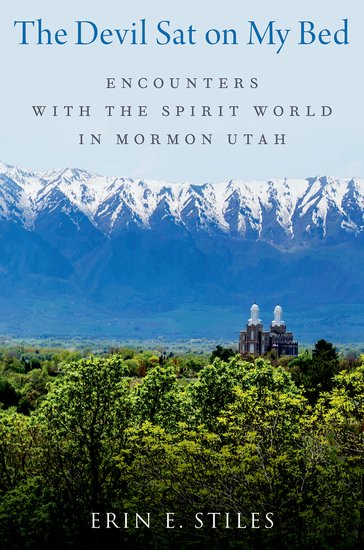
Erin Stiles is a professor at University of Nevada, Reno. She was raised in Cache County, located in northern Utah. She has authored a new, fascinating book, "The Devil Sat on My Bed -- Encounters with the Spirit World in Northern Utah," Oxford University Press, 2024.
Stiles is not a member of the LDS Church, but through her life experiences and research she has a strong understanding of Mormon culture. As she notes, spiritual encounters underscore a type of collective salvation, members of a familial lineage -- alive, dead or not yet born -- working in tandem to influence or prod family members through what Mormons call The Plan of Salvation.
Stiles recounts examples, gleaned through personal interviews and research through archives. One is a long-deceased mother who communicates to her daughter through voice and text messages. In one message, the deceased mother laments that she didn't spend more time with her daughter. Others include adults who talk about meeting spiritual children. Later a child is born who resembles the spirit.
These good spirits often have names, or the living person senses they are a descendant, and later discovers that to be the case.
As noted, Mormons tend to see morality as a concept and righteousness as a verb. That helps understand why Mormons are receptive to spiritual encounters. Mormonism regards works as paired with faith in receiving a degree of salvation or higher. The spirit world is divided between a type of paradise and "spirit prison." The latter is not really a prison. It represents people who need to be taught Latter-day Saint principles and ordinances of the Gospel. Under Mormon theology, it makes sense to continue religious duties after death. I can't tell you how many times I have heard at LDS funerals where someone will remark that "Brother or Sister (so and so) are really busy teaching the Gospel" in the spirit world.
Temple work is important in the LDS faith because it's designed to provide the deceased a choice to follow what LDS faithful believe are covenants necessary toward a higher degree of salvation, called exaltation. As Stiles notes, it is always a choice of the person. It's not a decree. The idea of agency is important within the faith.
For that reason, unsurprisingly, Stiles has gathered accounts of spiritual encounters within temples, interaction with spirits who have chosen to receive the post-mortal ordinances. I found fascinating accounts of people performing baptisms for the dead seeing spiritual people watching the baptisms. After every baptism, a spirit would leave, presumably satisfied with his or her baptism.
One of the accounts recall a child spirit left alone after the series of baptisms. This child, seen by one of those performing the ordinance, appeared very distraught. The officiator was asked to review the list of deceased slated for proxy baptism. It was discovered the man had missed one to be baptized. Once that occurred, the child spirit left.
I remember one of my late sisters telling me that she had conversed with the deceased spirit of one of our aunts, who died when I was very young. She eagerly conversed with my sibling, still a child. Frankly, I believe her. These are not carnival tricks to Latter-day Saints. Spiritual encounters occur, as the book notes, to guide those on earth, to protect them, and -- most in my opinion -- to comfort. Expressions of love extend beyond the grave.
As Stiles notes, adversarial spiritual encounters are generally nameless. They include demons on beds, bad ouija board experiences, encounters with Cain. There are many accounts of missionaries dealing with bad spirits. Although the term demon is often used in popular culture, most Mormons would regard these visitors as being rebellious spirits who aligned with the devil, Lucifer, in the pre-existence and were cast out to -- ironically earth. They were denied bodies. Mormon theology considers the number to be a third of all people created.
An example in the book involves unseen spirit women who were whispering to missionaries late at night. The sounds were so loud the missionaries faced accusations of having girls in their rooms. I'm not sure about this one. It may derive from sexual frustration. However, as a missionary myself, we swapped tales of dealing with the adversary. Another involves rebellious spirits attempting to enter the Logan LDS temple. This is a well-traveled tale. The spirits are stopped, but in some accounts do manage to disrupt temple activities. *
In both cases, males in the Mormon faith used what is called Priesthood authority to cast out the renegade spirits. The patriarchal culture of Mormonism provides near-absolute authority to males in ecclesiastical matters. Stiles notes that in the early years of the LDS Church, women had much more power to "perform ordinances" before church leaders cracked down on that in the early 20th century. Candid interviews with current members provide evidence that the future may hold a loosening on overly patriarchal attitudes on female participation in Gospel ordinances.
"The Devil Sat On My Bed ..." contains fascinating information. It brings to an academic setting what's long been discussed between families, in pews, in Sunday school, firesides, campouts, sleepovers, family reunions, and so on. What happens in northern Utah really happens just about everywhere in Mormon culture. Hopefully this book, which can be a tough read at times due to its academic style, will lead to more books on spiritual encounters and how they relate to Mormon theology and culture.
* I have no disagreement with Stiles' stance that most adversarial spirits are unnamed. However, I have spoken to a handful of people who have a feeling these bad spirits they encounter are acquaintances, or friends from the pre-existence, but chose to follow Satan. Given Mormon culture, I think that idea is worthy of further study.

