Saturday, April 22, 2023

H. Dean Thompson was a teacher, historian, comedian, marimba player


----

(Originally published on April 22, 2011. I am rescuing from archive oblivion this great Cal Grondahl cartoon that went with original post.) 

attended the funeral today of H. Dean Thompson, 79, of Ogden. A retired Ben Lomond High School teacher, he had a remarkable life. I only got to know Dean six or seven weeks ago. We swapped several e-mails that involved a shared love of LDS history. He sent me two family history books, fascinating, detailed biographies of his family stretching 200-plus years, with many anecdotes. 

I wanted to meet Dean. I was invited to his home. Two Saturdays ago, while packing his marimba equipment (Dean entertained at senior centers), he had a heart attack that would claim his life. He wrote several history books and an autobiography. After reading two, I’ll always regret only having the chance to see him in his coffin.

I want to share some of the history Dean recounted in his books, not only because it’s interesting but also because I suspect many longtime local families have similar histories. Perhaps it will inspire others to do what Dean did — preserve the memories of how our grandparents, great grandparents and earlier ancestors laid the foundation for the lives we enjoy today. The following is from “History of Heber Charles Gibson and Mary Amanda Bitton Gibson and their Pioneer Ancestors.”(Likes Publishing, Orem, Utah):

Dean’s grandmother, Mary Amanda Gibson, traced her LDS roots as far as her great-great grandparents, who joined the church in New England in the 1830s. Erastus Bingham, for example, was baptized with his wife Lucinda in 1833 in Vermont. Years later, when the couple and their family lived in Nauvoo, Brigham Young told them that an early church council held in their home in Vermont was the only meeting where are 12 Apostles were together during that era.

Now switch to the union of Wheatley Gibson and Selena Gibson, parents of Dean’s grandfather, Heber Charles Gibson. (The H. before Dean’s name is for Heber). Wheatley and Selena were born in England, and made their way over the plains to settle in the Weber area. He was 21, she was 16, when they met and fell in love immediately.

As Dean recounts from the sources he painstakingly researched, Wheatley and Selena fought “the cricket wars” of 1867 to 1872, where grasshoppers ate more up to three-quarters of the crops. Millions of crickets were fought with prayers, fires and little more.

Soon after the “the grasshopper wars,” black diphtheria struck the community, and Wheatley and Selena’s family was not exempt. Between 1877 and 1878, the couple watched helplessly as their children struggled. Two died and Selena barely escaped dying. Dean writes, “These epidemics must have been very frightening because so many died and because of the primitive state of medical care.” From his research, we learn that our Top of Utah ancestors used as medicine golden seal, bayberry, sulfur and molasses, cayenne pepper, etc.

I move forward to Dean’s grandfather, Heber Charles Gibson, farmer, bank board of director, faithful Mormon, and staunch Republican. Heber lived almost 90 years until the mid 1970s. His wife, Mary Bitton, died 10 years earlier. She was very active in the West Weber Relief Society. But I digress: In his research, Dean learned from former Democrat and U.S. congressman Gunn McKay that bishops used to go door to door in Huntsville assigning political parties to ward families. But these chosen political ideologies often stuck.

Dean recounts a relative’s assertion that Heber himself had had his family chosen Republicans. In an amusing anecdote, Dean recounts in the book that within the family assigned Republicans married assigned Democrats, which “caused a few heated discussions at family gatherings.”

What Dean saved for future generations with his painstaking, well-researched, detailed family histories is priceless, and of more value than any material wealth. He’s gone from the Earth, but I don’t for a moment think Dean Thompson is without many friends. What a great time he must be having right now with Wheatley, Selena, and the others.

-- Doug Gibson

Friday, March 31, 2023

C.S. Lewis, The Great Divorce, and the LDS Spirit World


---

A couple of times a year, usually on a Sunday after church, I re-read C.S. Lewis’ marvelous post-mortal novella/fable “The Great Divorce.” It relates a journey of diminutive spirits (referred to as ghosts) to the outskirts of Heaven, where they are greeted by much larger, more powerful exalted spirits, eager to help them take a painful journey beyond the mountains to Heaven. The journey, and its accompanying pain, is a metaphor for repentance and shedding of sins.

Most of the “ghosts,” despite the mild persuasion of loved ones, friends and acquaintances who greet them, refuse the trip to Heaven. They prefer Hell because it allows them to retain their earthly passions and sins, obsessions, earthly pride, angers resentments, self-pity, manipulation, and narcissism. That is the foundation of what Lewis is teaching in his novella; that one must surrender the earth for Heaven.
As Lewis writes, “There are only two kinds of people in the end: those who say to God, ’Thy will be done,” and those to who God says in the end, ’Thy will be done.’“
”The Great Divorce“ can be called Dante-like. It’s a journey with many experiences, with a narrator and a teacher. Understand, I make no claim that C.S. Lewis saw any similarities between ”The Great Divorce“ and the Mormon concept of the post-mortal spirit world. In fact, Lewis — on more than one occasion — reminds readers that his story is a fantasy, and says, ”The last thing I wish is to arouse factual curiosity about the details of the after-world.“
Personally, I think Lewis had his tongue in his cheek with that remark, because of course ”The Great Divorce“ ”arouse(s) factual curiosity about the details of the after-world.“ And the concept of spirits retaining their weaknesses and more exalted spirits zealously attempting to teach them ”the right“ is a central tenant of Mormonism. But let me backtrack: From my earliest years in the LDS Church, I was taught that after we die, we either go to paradise or ”spirit prison.“ (For many childhood years, I envisioned ”spirit prison“ as a clean jail with bars, where orderly ”wicked“ spirits waited for good spirits to teach them the Gospel ...)
Instead, Mormon theology puts the spirits world as being on the earth. In the Book of Mormon, the prophet Alma taught that — like Lewis’ ghosts — what’s learned and appreciated on earth is carried to the spirit world. In the LDS post-mortal spirit world, there is no confirmation of any ”correct Gospel.“ Spirits congregate where they are most comfortable. The ”righteous“ spirits — like Lewis’ spirits — attend to spirits who need to learn the truth. I imagine much of the ”missionary work“ is without success. (As a lifelong Mormon, it’s impossible not to imagine these spirit ”missionaries“ as wearing dark suits and ties, or sisters in dresses, and carrying flip charts and Scriptures as they knock on doors in ”Spirit Prison.“)
In ”The Great Divorce,“ Lewis talks about many ghosts who are so obsessed with their earthly lives that they return to homes, places of work, etc., and ”haunt“ them. (Now, what I’m saying next is ”Doug doctrine“ and not LDS belief, but one reason I flinch at watching LDS football on Sunday is that I have this feeling a host of spirits — all obsessed with the Dallas Cowboys, etc., are also watching the game. If I turn the tube off and put on a CD of church music, they’ll take off! I also wonder about those kitschy reality ghost-hunting shows on TV. Are the malicious spirits having fun with us humans?)
(Yeah, I’m still being tongue in cheek now but what comes next is serious.) Lewis’s relating that the souls of purgatory/hell were handicapped by their earthly attachments parallels the LDS belief that missionary spirits are attempting to teach other spirits to shed those same attachments. A chief distinction, of course, is that Lewis considers his ”Hell and Heaven“ as the end result, while LDS theology sees the ”Spirit World“ as a far earlier part of our eternal existence. It is interesting, though, that ”The Great Divorce“ envisions active efforts to convert unbelievers after death; a concept that Mormonism can relate to. ”The Great Divide“ also places a person’s humility and true charity as more favorable than excessive religion and excessive charity, reminding the reader that these can become earthly obsessions which consume our other responsibilities.
As former Standard-Examiner cartoonist Cal Grondahl says, religion exists in one part to comfort us about our approaching death. C.S. Lewis, as a Christian, believed in life after death. To the righteous, his novella comforts, as the Mormon Spirit World comforts devout Mormons. I have no idea if Lewis regarded Mormons as Christians, but his novella — in which spirits find themselves more comfortable in dim, dreary, contentious surroundings and resist missionary efforts that offer a more exalted state — connects with LDS doctrine.
Also, it’s very interesting that in Lewis’ ”Hell,“ there are ghosts who have strayed so far away from the ”bus station“ that offers ghosts the opportunity to visit ”Heaven.“ As a result, they can’t go to Heaven’s outskirts anymore. This is similar to LDS doctrine, in which spirits in ”spirit prison“ are separated by those who are still teachable and those who are not. I recommend ”The Great Divorce“ to anyone, of course, but also to LDS readers who will find the unintentional similarities very interesting.
-- Doug Gibson
This column was previously published at StandardBlogs.

Sunday, March 12, 2023

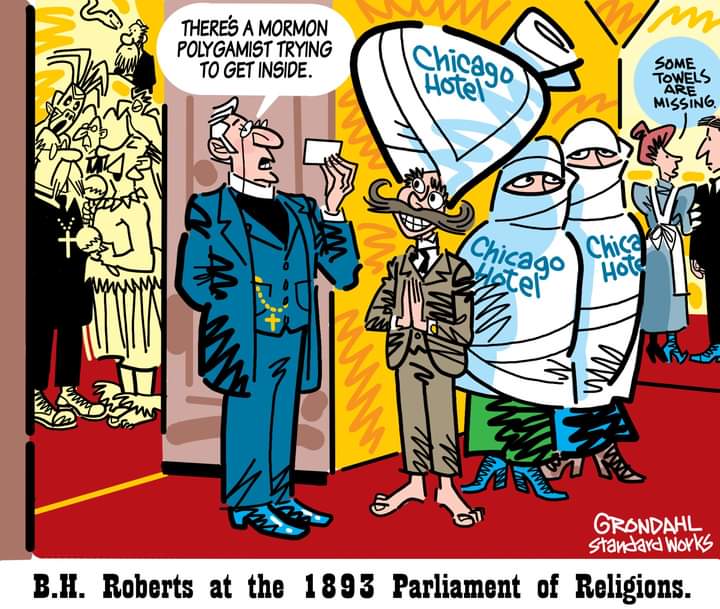
Secular appeal helped Utah to be a big hit at 1893 Chicago Congress


In contrast to the Mormon Church’s bitter rejection at the 1893 Chicago Parliament of Religions, the territory of Utah was warmly received at the Congress of States and Territories, recounts historian Konden R. Smith in his Journal of Mormon History essay, The Dawning of a New Era: Mormonism and the World’s Columbian Exposition of 1893. (Both events were part of the Chicago World’s Fair). As Smith writes, “In contrast to Mormonism’s rejection from the Great all, Utah Territory … was granted the coveted ‘Lot 38’ in the Congress …” Smith adds that Utah was “thrilled.”

“Lot 38” was one of the largest and situated in the middle of the hall. The reason for Utah’s success was simple: Mormons and non-Mormons in the territory — united in a desire to become a state — stayed away from the religious aspects of Utah, and emphasized its secular strengths. As Smith writes, “Its (Utah’s exhibit) central objective was to make a good impression on visitors, creating an image of Utah characterized by its great potential as a valuable future state with exemplary citizens.” 

The successful exhibit focused on “agriculture, mines, manufacturing, fine arts, ethnology and archaeology, education, women’s work, and a bureau of information” from spectators. Ogden Catholic and mineralogist, Dominick Maguire, educated fair attendees on Utah’s minerals. 

The territory promoted its granting of the vote to women as proof of its feminist appeal. Utah’s then-Gov. Caleb W. West, who was not Mormon, dismissed talk of a theological rule in Utah, saying, “In times past there have been struggles and differences, and I mention these only to say that they exist no more. They have been buried and now we bespeak for Utah simply justice,” recounts Smith.

Most notably, the LDS Prophet Wilford W. Woodruff spoke on Utah Day in Chicago, but he spoke not as a religious leader, but as oldest living pioneer, writes Smith. The Congress certainly went a long way toward achieving Utah statehood in three years, and the effort paid off in highly favorable press coverage. The New York Times, for example, dismissing any threats from Mormonism as remants of the now-ended Brigham Young era. 

The Times also derided opponents of Utah statehood as “non-Mormon ministers, who were spouting fears of now-dead policies such as “polygamy,” recounts Smith. Of course, polygamy was not quite gone. It’s amazing that two separate battles were waged by the church; one by itself, the losing effort to include the LDS faith at the Chicago fair; and the other, very successful campaign, with non-Mormons, to promote Utah territory.

As mentioned in the previous post, the Chicago World’s Fair was promoted as the end of the frontier times. In many ways, that is an apt description for the evolution of the Mormon faith. Its determination to be included in national events, its determination to be a state, were in sharp contrast to the church’s anti-government, distrust of external authority it had promoted only a generation or two earlier. 

The current Mormon Church hierarchy is often described — sometimes with admiration, other times less admirably — as having strong public relations skills. Its success at the Congress of States and Territories is proof that today’s promotional skills were inherited from leaders more than 100 years ago. 

The ecuminity between Utah’s Mormons and “gentiles,” Smith explains, was a realization that an end to popular fears and prejudices against the Mormons would benefit all Utah Territory residents.?As Smith also notes, the relatively new Mormon Tabernacle Choir was a big hit in Chicago. The 400-plus members of the Choir performed in Chicago on Sept. 8, 1893, to lots of acclaim, including a favorable review in The Chicago Daily Herald.

It is notable that after the Chicago events were over, Mormon leaders, including George Q. Cannon and Lorenzo Snow, Francis M. Lyman, and Heber J. Grant, at LDS General Conference in October, ignored the repudiation of the church itself and focused on the positive results of Utah’s exposure at the Congress.

As Smith notes, it was a moment of realization for late 19th century Mormons, “that, if they hoped to accomplish their goals as a people — they could not do so when ‘all hell” raged against them. Rather, Mormons by finding acceptance as American citizens who believed in progress and social reform, sought a position of equality rather than marginalization and oppression.”

In short, the secular triumphed over the theological.

-- Doug Gibson

Originally published in 2011 at StandardBlogs.

Tuesday, February 28, 2023

Spiritual comfort food from the latest LDS conference, from 2010


I wrote this piece almost 13 years ago for the now-defunct StandardBlogs and rescued it from Wayback. I found it interesting, still agree with most, although I was likely wrong that the good Elder Bednar will become the prophet. -- Doug Gibson

Since I returned from my mission; and that was 25-plus years ago, I’ve thought of LDS General Conference as LDS comfort food — far less fatty than Oreos, but often not much more nutritious than a rice cake. I figured out a long time ago — and I think the conference speakers would agree — that ultimately it’s up to me to figure out what’s best for myself, and along with my wife, what’s best for her, us, and the kids.

Let’s face it: the latest very heartfelt account from President Thomas S. Monson about someone who died tragically leaving a great testimony can provide a big dose of spiritual Jolt, but it wears off after a few hours.

These years, at conference time, I listen for talks on how to raise kids so that they’ll still want to go to church at that time near or at adulthood when my advice won’t mean as much to them. Elder L. Tom Perry and Elder David A. Bednar provided some good advice. The former stressed the need to make sure that the Gospel is taught in home as much as church. Elder Bednar, who I believe will be the prophet in my children’s formative adult years, reminds parents that if they want their beliefs to stick with their kids, they have to bear witness constantly of them. Of course, even then we may have to accept that a child will follow a different path. In the working draft of a biography of Spencer W. Kimball, “Lengthen Your Stride,” a small portion of the book reveals the late prophet’s anguish over his son, Spence, deciding Mormonism was not for him. I fear that anguish.

I was impressed with a pair of talks that President Dieter F. Uchtdorf gave. At the Priesthood session, he provided an excellent lesson on the difference between “patience” and “endurance.” The former is an active part of achieving a goal or perfection. It’s a virtue and something godly. That leads to a lesson: As God is patient with us, we should be patient with others, as well as with ourselves. It’s sad to think of how many people spoil their potential, either in a secular or religious sense — because they give up on themselves.

President Uchtdorf also offered excellent counsel on Sunday morning. He urged against pride and said that we should look beyond what may offend us personally and show the same tolerance and love that Christ shows for all of us. Condescension, or talking down to another person, is also not Christ-like. The irony, Uchtdorf explained, is that extending acceptance and love to others strengthens and refines our spirits.

Elder Jeffrey R. Holland, who headed BYU when I went there (I once met him as part of the Daily Universe editorial team) gave a strong attack on pornography and offered suggestions to combat it, such as talking to a bishop, prayer, the Church Web site. I don’t necessarily disagree — I think pornography is far more dangerous than many think. It destroys intimacy in relationships, objectifies the opposite sex, among other problems … — but I sometimes wonder about the practicality of “prevention” advice given to people who have healthy attitudes about sex but are struggling with normal urges in regards to sex.

When I was a young teen, a well-meaning adult member of the church told me that masturbation would lead to excommunication. For years I assumed that would be the penalty for what I occasionally engaged in. The guilt I felt was both overwhelming and a waste of energy. I have a young son and there is absolutely no way I am going to put him through that same kind of guilt trip. Instead, he’ll learn in several years that although dad and mom want to keep an eye on his reading and watching material, there are some things that we’ll take in stride.

And despite what he may hear from others, that is not a sin at this stage in his life.

Sunday, February 5, 2023

Rarely seen 'Corianton: A Story of Unholy Love, 1931, packs BYU's Varsity Theater


Review/observations by Doug Gibson

For about a couple decades, I had longed to view the early sound film "based" on a segment of The Book of Mormon. It's "Corianton: A Story of Unholy Love," 1931. With artistic license, it tells of Alma's somewhat troublesome son, Corianton, and his involvement with the harlot, Isabel. This is all part of Alma's letters to Corianton in Book of Alma, chapters 39-42.

Now that's not Isabel reclining and wearing very little in the poster above. But the woman -- an extra -- is in the film, and dressed as such. Corianton ... premiered in Salt Lake City and then promptly flopped at the box office. Ultimately, more money was likely earned by lawyers litigating over the film than at the box office. It's a low-budget black and white film that once aspired to be in color. The Great Depression cut fundraising severely, and it limps to its climax, with the final scenes - a battle between the Zoramites and the Righteous -- a mixture of stock footage from the 1922 big-budget film "Sodom and Gomorrha," and the Corianton ... film actors passionately fighting, arguing, and dying on what looks like a stage.

Nevertheless, I loved this film after watching a restored version that played at BYU's Varsity Theater the last Friday of January. The BYU Motion Picture Archives hosted the event, and the Varsity Theater was packed. (Granted there was no charge, but that's still a great crowd). Panelists -- including author/historian Ardis E. Parshall, and Ben Harry, curator of BYU's Motion Picture archives, provided commentary before and after the film.

(A lot of the back history of this film mentioned in this blog post, as well as many of its artistic merits, pro and con, was also observed by the panelists and noted in a book on Corianton edited by Parshall. Here is one still from the film, below.)


Parshall, by the way recently edited a book -- The Corianton Saga -- covering the history of the Corianton story adaptations. It was first a novella by LDS General Authority B.H. Roberts, titled Corianton: A Nephite Story, then adapted into a play by an eccentric Latter-day Saint named Orestes U. Bean, who developed an obsession with the story he had appropriated from Roberts, as well as another late-19th century Book of Mormon-themed novel titled, A Ship of Hagoth, by Julia A. McDonald.

The play was titled "Corianton." It played well in what is described as the "Mormon corridor," or areas heavily populated by Latter-day Saints. When its backers took the play to parts east of the Rocky Mountain West -- including New York City -- it failed. In New York City, Bean titled it "An Aztec Romance."

A little backstory: In the late 19th century, there was an effort from LDS leaders to create art from the Scriptures, and the church's doctrine and its early struggles. Besides the aforementioned books that resulted, there was Nephi Anderson's tale that included the pre-existence, Added Upon. That book was in my family's library as I was growing up. Besides novels there were plays and short stories. I recall reading one by Anderson in which a lazy LDS teenager -- too bored to attend church -- was thrust into a dream where he experiences the pre-Utah persecution of the Saints. This sort of "'Mormon Renaissance" was the precursor of the film, "Corianton: A Story of Unholy Love."

I know I am meandering so I'll try to get to the film. In the 1920s, an entrepreneur named Lester Park, after watching impressive films like "Ben Hur" gain notice, acclaim, and box-office money, decided that the story of Corianton would be box-office gold. The project was successful early, and even the tepid resulting film has evidences of the early money. It was filmed in New Jersey. Its music composer was from "Ben Hur," The film's orchestra music was overseen by the former head of the Metropolitan Opera Orchestra of New York City. Professional dancers were in the film, and the LDS Tabernacle Choir and Great Organ is heard in the film. I mentioned that an original idea was to shoot the film in color.

But, as mentioned, the money started to dry up. And there was a second problem; the play's mercurial, eccentric, odd, creator, the aforementioned Orestes Bean. He had finagled himself a lot of control over the production, which caused headaches for director Wilfrid North and the film crew. In fact, a lot of the film was shot in a hurry while Bean was off getting married, and absent from the set.

Corianton ... starts with the trial of Korihor. Corianton is a fan of the apostate, and critic of his father Alma. His faith is re-energized once he sees Korihor struck dumb and he goes off on his mission, with his brother Shiblon. Once with the Zoramites, though, he becomes too friendly with Zoramite nobleman, Prince Seantum. Seantum conspires with his mistress, Isobel, to get Coriantumr infatuated with her. The plan, which works to perfection, lures Coriantumr to a swinging Zoramite party where he's fed lots of wine by Isobel. Once his drunkeness is publicized by Seantum and others, the reputation of the missionaries is tarnished.

Prince Seantum is not in The Book of Mormon. Nor is a woman named Relia, a pious woman who is engaged to Shiblon but actually in love with Corianton. Meanwhile, Isobel, despite her treachery, falls in love with Corianton, who feels regret at what he has done. This all really upsets Seantum, who plots not only the murder of Corianton and Isobel, but plans to lead an army and destroy the righeous Nephites. The climax of the film is that battle.

I'm conditioned not to reveal the end of movies, which is kind of unfair since Harry told the audience at the Varsity Theater that there are no plans to release this film, as a DVD, or on YouTube, or on TV. However, interested readers can purchase the book Parshall edited, as it contains the entire film script.

This is not a traditionally good movie. I would give it 1.5 stars out of 4. But it's still so interesting to watch. If I could, I'd buy 40 copies and give them to likeminded friends. As Harry noted, "(the film) is a holdover from an earlier era." Pomp and majesty, and drama, and very loud talking is how the film conveys its religious message. It's not like films today which focus on emotion and deep spirituality to convey a religious message. As Harry noted, it's a lot like "Ben Hur" was in its religious delivery.

"We need to watch with one eye in 1931 and one eye in 2023," Harry added. (See another still from the film below.)


My opinion of the film is that it mixes three different artistic styles, the creaky, still under-developed sound technology of 1931, the pantomime, emotional style of silent cinema, and the loud, let's-project-our-voice-through-the-auditorium of the traditional stage. (Harry also noted a couple of these observations.)

Much of the overly emotional, tragedian (particularly from the actor who played Shiblon) acting in the film is risible today, and there were a dozen-plus incidents in the film that evoked respectful laughter.

As was noted by Parshall, an unhealthy influence of too much Orestes Bean found itself into the script as the film progresses. Suddenly, the actors started to talk in a Shakespearean manner. "(Bean liked) thees and thous," Parshall told the audience. Parshall does note that these were talented artists, on both sides of the camera.

Much of the film's faults are due to the lack of money as filming progressed. The "Beanish" script didn't help, and the normal-for-the-times overly dramatic, tragedy-like lamenting over-acting doesn't go over well today, and invites giggles from the audience. Those who have read The Book of Mormon, I feel comfortable saying, won't see "Korihor," or "Alma," in the actors on the screen.

One favorable note for this film is it underscores the progressive nature of Mormonism when it comes to salvation. During the climax, actors express their confidence that God will forgive them of their sins, accept their repentence, and welcome them to heaven. In fact, one character claims that he received revelation that Korihor had been saved.

Also, the two leads, Eric Alden as Corianton, and Theo Pennington, as Zoan Ze Isabel, are great in their roles. (In what strikes me as humorous, I learned at the film showing that Bean's wife eventually changed her name to Zoan Ze Isabel. Bean, by the way, in the latter years of his life, lectured on his play/movie extensively in southern California, to large crowds. He had a missionary zeal for it.)

Finally, I want to mention one more interesting fact about "Corianton: A Story of Unholy Love." It's a fairly racy film, although that was not uncommon in that film era. There are many dancers dressed like the woman in the above poster. And there is a scene, where an angry Corianton is confronting a penitent Isobel, where Theo Pennington is visibly nude under a thin negligee. One panelist, I cannot recall which, did opine that box office receipts likely dropped after parents had second thoughts about children attending. Frankly, the film would probably garner a PG or PG-13 today, or soft R if the MPAA was in a prudish mood.

I am so glad I saw this historical gemstone. It has so much much value, particular for the cultural history of Mormonism. I appreciate Parshall, Terry and others for publicizing the film and restoring it. It played a decade or so ago at BYU but I missed it. This newer restored version include subtitles, which was helpful. The audience clearly appreciated the film. Harry promised the film will eventually get another showing, and said that a new print has been discovered in California, under a different title. 

(Below, one more still/poster, with the leads "Corianton" and "Isobel.")


Sunday, January 22, 2023

Utah County Dream Mine still attracts LDS apocalyptic faithful


--

This blog post was originally published in January 2011 on the now-defunct StandardBlogs. To my knowledge there are still many invested in the Dream Mine, although no work searching for riches goes on at the site. According to Wikipedia, there was an investors meeting in 2018. 

One of the more fascinating nuggets in Utah Mormon history sits at the foot of a mountain in southern Utah County. Its official name is the Relief Mine, but most know of it as the “Dream Mine.” A long-used white mill building sits next to the mine, mostly inactive for decades. Nevertheless, the Relief Mine is a public company with assets of about $3.5 million. Stock in the mine is traded and there’s a waiting list to buy shares.

As Payson, Utah, writer/historian Kevin Cantera writes in the most recent Sunstone, “investors seeking to purchase a stake in the mine happily place their names on a waiting list for the chance to pay $30 to $35 for a single share — shares with a real value, by the most generous accounting, of less than $10 each.”

Cantera’s piece, “Fully Invested: Taking Stock in Utah County’s Dream Mine,” is as much a history lesson as it is a glimpse into the first 80 or so years of the LDS Church, where visions and prophecies from higher, celestial powers, whether from dad, your bishop or a general authority, were common. That’s a lost era. If a ward member gets up today and claims to have seen Christ or the Angel Moroni, we’re apt to trade concerned glances with our seat neighbors and look embarrassed. The bishop might call a regional rep if the claim is repeated. Can anyone imagine one of today’s apostles recounting experiences that early apostle Parley P. Pratt records in his diary?

The shareholders in the Dream Mine are a throwback to the 19th century. They believe that deep into the Utah County mine there are piles and piles of gold and other precious artifacts, collected by the Nephites of Book of Mormon times. As Cantera recounts, some believe that perhaps the Sword of Laban, or even The Golden Plates, are hidden deep in the earth. The Relief Mine stockholders of the early 21st century aren’t looking for a return that will prompt a hefty capital gains tax. They expect their mine to pay off when the United States is on the brink of collapse and the dollar and other secular monetary systems have fallen.

The precious metals from the mine, and its relation to the Gospel, they believe, will save our nation from destruction in the last days. It’s an apocalyptic desire, one that was much more common 100-plus years ago, when a healthy percentage of blessings and priesthood ordinances promised the recipient that he or she would see the second coming of the Savior.

The prophet who launched the dream mine was Mormon bishop John Hyrum Koyle, who in 1894 claimed a nightime visit from the Angel Moroni, who showed him inside a mountain where there was a rich vein of gold. Lower down were nine caverns filled with Book of Mormon treasures, including the Urim and Thummim.

Koyle spent a long life preaching the doctrine of the Dream Mine and receiving revelations. He had some prominent LDS shareholders, including general authority J. Golden Kimball. The fact that there are still more than 1,000 faithful Latter-day Saints who believe Koyle’s claims underscores faithful Mormons’ strong belief of personal revelation from God. What was shouted from the pulpit long ago is regarded as best kept as a secret today, but there are enough apocalyptic Latter-day Saints out there to follow Koyle’s dream 117 years later.

And, although Koyle — after taking his spiritual mine public — was eventually repudiated by church leaders in 1913, and finally excommunicated in 1947, there are still mine stockholders, including Ogden’s Fred Naisbitt, who is quoted by Cantera as saying, “Koyle is second only to Joseph Smith in the number and accuracy of his prophecies.”

The white mill, which only gleaned 100 dollars worth of ore one year, still sits by the mountain near Spanish Fork, which draws more subdivision neighbors each year it seems. As Cantera reports, the Internet has strengthened the faith of the Dream Mine believers. The Web site is http://www.reliefmine.com but doresn't seem to work now. It had featured a glowing testimony of Koyle and links to other primitive LDS beliefs such as the White Horse Prophecy as well as notices that “the dollar will be utterly destroyed.” There is a Facebook page with contact information.

Who knows? Maybe the dollar will be destroyed. But to most Mormons, even in Utah County, the longer odds are on the Dream Mine one day paying off.

-- Doug Gibson

Thursday, January 12, 2023

Lost Apostles a fascinating look into the early years of the LDS Church


Signature has a Mormon history book, "The Lost Apostles: Forgotten Members of Mormonism's Original Quorum of Twelve," that provides a valuable look at the early years of Mormonism. Authors William Shepard and H. Michael Marquardt outline characteristics of the original apostles. They were mostly frontier men, chosen for their candor, stamina, independence, testimonies and personalities. These 12 were not administrators; they were young action-oriented men, sent out with virtually no assistance to study during the day, preach at night and try to baptize enough new members to form a small branch. If they were rejected, they left the "unbelievers" with a curse. If an apostle encountered a comely, unattached young woman, it was not uncommon for him to marry her, enjoy a quick honeymoon, and then go back to the mission, with a young wife waiting for his return.
The "Lost Apostles" are John Boynton, Lyman Johnson, his brother Luke Johnson, Thomas Marsh, the first president of the 12, William Smith, brother to the church's founder, and William McLellin. To those with at least an acquaintance of Mormon history, perhaps only Boynton and Lyman Johnson are historical strangers, no more than pictures in a church almanac. They are the two who managed to divorce themselves emotionally from Mormonism. Of the others, two -- Marsh and Luke Johnson -- returned to the now-Utah church, one, McLellin, skipped from Mormon offshoot to offshoot, never content, and William Smith, the legitimate rogue of the outfit, was finally allowed into the reorganized LDS church led by his nephew, ... so long as he behaved himself.
"Lost Apostles," is most interesting when it details the passions, strife, successes, setbacks, celebrations and violence that characterized Mormonism's growth in the 1830s, prior to the emigration to Nauvoo. As Joseph Smith moved the Mormons into the frontier, there were inevitable clashes between the unified newcomers and the older settlers, who didn't cotton to a large new voting bloc roiling the land. A lack of tact and propensity toward violence from both sides inevitably led to outnumbered Mormons being forced out. These exoduses were conducted under duress, in dangerous situations, and innocents died. Although the apostles were supposed to be separate from administrative duties, in reality they were not. They were often caught in the conflicts, internal and external, that roiled Mormonism.
What led most of the "lost apostles" from Mormonism was the 1838-1839 years in Ohio and Missouri. Besides the increasing violence, which became deadly, church leaders made the common mistake of wanting to get rich quick. They started an "anti-bank," due to not being able to get a charter, and created their own money (this could be done 180 years ago). During a brief real estate bubble, investors imagined themselves rich. The bubble broke, sellers and investors wanted their money, and the "currency" of the financial institution became worthless. As the authors detail, there's nothing like disputes over money to destroy harmony. Boynton, the Johnson brothers, McLellin, and later Marsh, left the church during this period. Other prominent church leaders who left were Oliver Cowdery, Martin Harris and David Whitmer. Others who came close to long-time estrangement include apostles Parley P. Pratt, his brother Orson Pratt, and Orson Hyde. William Smith, a product of nepotism, clung to the quorum due to his familial relationship. However, after Joseph Smith was murdered in 1844, his thuggish behavior was not tolerated much longer.
There is a paradox in this account. All of these men witnessed what they believed were heavenly manifestations, they believed that Jesus Christ had blessed them through revelation and assigned them to be apostles.So why was the quorum shattered by greed and violence in only several years? The authors do note that despite disagreements that flared into violence, all of the men were either cordial to, or even confidantes toward one another for the rest of their lives. They were generally kind to the members of the faith they had left. Even John Boynton, who became a celebrated physician and inventor in the mid-1800s, took time out of a tour to visit his old friends in Salt Lake City. Boynton was a man who made pains to avoid mention of his youthful adventure with Mormonism, but decades later, was drawn to reminiscing with his old companions. The short answer to the paradox is that most of the early leaders of the "Mormonites" retained their belief in the Book of Mormon, as well as the early appeal that it was a book designed to usher in the return of Christ, within a generation. Their reasons for leaving, or being forced out via excommunication, were probably close to what the loquacious McLellin often said; in their opinion, the leaders, Joseph Smith, etc., became corrupted, and fell short of the principles they believed the church required.
The "Lost Apostles" is a sympathetic account of the six, but not hagiographies. The commitment to Mormonism that drove these men to be early-Mormon historical figures is acknowledged. Most of the book covers various episodes of Mormon history as the apostles related to them. Late in the book the apostles' lives post-1844 (Smith's death) are covered. As a scholarly offering of Mormon history, it's another of a series of books, including biographies of Parley P. Pratt and Brigham Young, that are part of an ongoing process of shedding "teddy bear" accounts of Mormon history with more detailed, accurate, and fulfilling, "grizzly bear" accounts. The book contains a few 1830s' journalistic accounts of the apostles' missionary efforts that are fascinating to read.
I'll conclude the review with brief recaps of the six apostles and how their lives ended:
John Boynton: Like Lyman Johnson, he was one of two apostles able to shed Mormonism. He became a legitimate celebrity of the 19th century, with inventions, 4,000 lectures and fame as a naturalist doctor. His ultimately unsuccessful marriage to a much younger woman in 1865 was illustrated in Harper's Weekly. He died in 1879 in Syracuse, N.Y.
Lyman Johnson: He stayed close to the roots of Mormonism, and was involved in legal cases of interest to the church in the 1840s. Cordial to his former apostles, he never returned to the LDS church. Tragically, he died Dec. 20, 1859, when the frozen Mississippi River broke while he and another man were crossing on a sled. He had just rented a nearby hotel to run.
Luke Johnson: Even as an excommunicated member, Johnson, as a marshal, helped the Smiths escape from lawmen seeking the Mormon prophet. In 1846, he returned to membership in the church. He emigrated to Utah, where his skills as a dentist helped the pioneers. In Utah, he assumed a respected standing west of Salt Lake City, but was passed over when a spot in the Quorum of the Twelve opened. He died in July 1861, somewhat broken by the recent murder of his son. His younger wife, America, outlived him by 39 years and is buried in Ogden.
Thomas Marsh: Many Mormons know Marsh through the myth of him "leaving the church due to his wife's fight with another sister member over milk strippings." That is nonsense. Marsh left the church in Far West, Mo., because he opposed the violence of some church members' retaliation against anti-Mormons. He testified against the church in hearings. Some blame Marsh's testimony for the extermination order against Mormons issued by Missouri Gov. Lilburn W. Boggs. When, almost 20 years later, Marsh, poverty-stricken, in ill health, abandoned by his wife, and virtually friendless, requested to be admitted to the Utah church, it was granted. Marsh died in Ogden, a pauper, on Jan. 25, 1865. Despite his return to Mormonism, Brigham Young and other church leaders frequently mocked Marsh in his last years, even when he was on the stand with them preparing to deliver a penitent lecture. This cruel behavior indicates that the circumstances of Marsh's apostasy must have had bitter roots.
William McLellin: Thanks to his legacy of diaries, McLellin is a well-traveled figure in Mormon history. Considered a learned but temperamental man, McLellin, perhaps engaging in historical license, created a history of himself joining a church of pure christianity, anchored by the Book of Mormon, without priesthood, apostles, etc. The mercurial McLellin, who lived a very long life, stayed in contact with his former colleagues, frequently reproving them. He joined several offshoots of Mormonism, often as a leader, but eventually became disenchanted and would leave each, usually within several months. He died in 1883.
William Smith: As the authors note, Smith was a legacy apostle, chosen over Phineas Young because brother Joseph Smith requested William. Although the authors note that William Smith was devoted to his brother's church, he was a scoundrel. He was a lecher, a chronic adulterer, a man who enjoyed the company of criminals, and was easily capable of abandoning a wife and young children. He skipped to many offshoots of Mormonism, only to be thrown out of the groups as soon as his character was revealed. In the later years of his life, Joseph Smith III, first president of the Reorganized LDS Church, allowed a chastened William to lecture about his father's early years, but kept his uncle on a very tight leash. William Smith died on Nov. 13, 1893, a few days after catching cold during an RLDS speaking engagement.
-- Doug Gibson
This post was originally published at StandardNET